Distilled History

A Drinking Blog with a History Problem
November 12th, 2012 by Cameron

The Great Cyclone of 1896

The Great Cyclone of 1896

In the late afternoon of May 27, 1896,  a meteorologist by the name of Irl Hicks looked out the window of his observatory on 22nd street in St. Louis. He watched anxiously as black clouds and green skies loomed dangerously to the south.  An ordained minister, Confederate veteran, and publisher of his own almanac, Hicks knew exactly what was happening. By watching barometer in his office all day, he knew the air pressure in St. Louis was dangerously low. Shortly after 4 p.m., he ordered the storm doors to the building be closed. He instructed others to find safety and prepare for the tornado that was about to slam into the city.

As I’ve mentioned in previous posts (such as the T.S. Eliot post), one of the great joys of writing this blog is discovering where history happened in St. Louis. Recently, I met a woman who told me the third floor of her home in the Lafayette Square neighborhood was ripped off by the tornado Mr. Hicks correctly predicted over 120 years ago.  This piqued my curiosity, and I wanted to learn more about that day. I’ve found that most St. Louisans believe 1896 tornado was limited to the Lafayette Square neighborhood. In fact, it hit far more than that. The “Great Cyclone of 1896″  (as it would be known) ripped an eight mile swath of destruction through St. Louis and East St. Louis. To this day, it accounts for the single deadliest day in the history of both cities. It is the second deadliest tornado in the history of the United States (behind the “Tri-State Tornado” that hit Missouri, Illinois, and Indiana in 1925). Adjusted for inflation, the estimated $2.9 billion dollars of damage makes it the single costliest tornado in the history of the United States.

I also learned that my bike commute to work each morning nearly follows the path of the tornado exactly (except for the last leg into East St. Louis). Since I have quite a bit of time to kill on these rides, it’s been a fascinating event to think about each morning as I head to work.

Path of the Great Cyclone of 1896

Unlike Reverend Hicks, few St. Louisans had a barometer nearby to warn them of the tornado that touched down just past 5 p.m. In twenty minutes, 255 people would be dead. Over a thousand would be  injured.  Over three-hundred buildings were completely destroyed while  nearly eight-thousand were severely damaged. Homes were ripped from the earth, trees were uprooted, and boats were hurled across the Mississippi River. Factories, hospitals, and churches were flattened. The city’s most treasured public park would come to look like a battlefield. In just twenty minutes, St. Louis would be cut off from the rest of the world as every telegraph line out of the city would be severed.

The tornado first touched down near the City Poor House on Arsenal Street, just east of Hampton Avenue. This complex of brick buildings held over 1,300 poor, elderly, and impoverished residents. Few were given any warning as walls crumbled and chimneys toppled . Amazingly, nobody was killed. The tornado then jumped across the street and took the roof off an entire wing of the Female Hospital. It then twisted east, narrowly missing the hulking St. Louis Insane Asylum.  Still, not a single life was lost. That good fortune wouldn’t last long.

As it headed east towards Kingshighway Boulevard, the conical shape of the tornado became more pronounced.  It roared into Tower Grove Park at the south-west corner and cut across it diagonally.  It stormed through Shaw’s Garden (now the Missouri Botanical Garden), uprooting hundreds of trees and plants as it moved. To the north of Tower Grove Park, the Liggett & Myers Tobacco Company was building a large addition of buildings. Ironworkers were still high atop the girders when the tornado hit, causing many to plummet and be crushed beneath fallen iron and brick.

Liggett & Myers Tobacco Company

The tornado then crossed Grand Avenue and slammed into the Compton Heights neighborhood. Here it bounced around towards Jefferson Avenue, tearing off roofs, blowing out windows, and wrecking apartment buildings.  The tail of the tornado snapped around in a wide arc, wreaking havoc from Chouteau Avenue to the north and Russell Boulevard to the south.

The scene at Jefferson & Lafayette

It then stormed east into Lafayette Park and the elegant homes that surrounded it. The 36 acre park was turned into “a wasteland of stripped trees and stumps.” in a matter of seconds. Gazebos and pavilions were hurled into the sky. Pieces of the main bandstand were found over four hundred yards away. Many of the stately homes and churches that surrounded the park were laid to waste.

Lafayette Park

Lafayette Park was a place of beauty and joy to the residents of south city. The first public park in the city of St. Louis, its destruction delivered to them a severe blow.  Surveying the damage from the balcony of his home, a Lafayette Square resident named Charles Simpson openly wept. Although his family was safe, he lamented the destruction of the park he loved dearly. He turned to his son-in-law and said “It took forty years to grow those trees, and I shall never see their like again. The house I can repair, but my trees are gone forever”.

Lafayette Square

The tornado continued east, now bearing down on the massive City Hospital complex. Containing over 400 patients, the tornado ripped roofs and floors away. The crematorium was instantly demolished. One newspaper reported that a patient named George Wilson was sucked out of his second floor room. Amazingly, he landed upright and was able to run back into the basement of the building. Another patient was pulled from his fourth floor room and thrown over 150 yards away. Miraculously, that patient also suffered only minor injuries.

The City Hospital after the tornado

Moving past the hospital, the tornado was still gaining power. It reached its full fury in the Soulard neighborhood, near an intersection that would come to be known as the “vortex”.  Here, at the corner of Seventh and Rutger Streets, a man named Frederick Mauchenheimer owned a tavern on the ground floor of a tenement building. As he sat at a table playing cards with two patrons, the tornado slammed into the building. Every floor of the building collapsed down. Mauchenheimer survived, but the other card players and fifteen others died. Six more people died across the street. The day after the storm, the body of seven-year old Ida Howell was found in the arms of her mother.

The scene at the corner of Seventh & Rutger streets

After wreaking havoc in the Soulard neighborhood, the storm turned north and continued its carnage on the riverfront. Over twenty steamboats, tug boats, and ferries were ripped from their moorings and destroyed. The steamboat “Anchor Line” was hurled across the Mississippi, crashing into pieces on the eastern shore of the river. Although the official death toll on this day is 255, many believe the number is much higher. On the riverfront, scores of people lived in shanty boats. Since their bodies were washed downriver, perhaps as many as 150 deaths were unaccounted for.

Wreckage of the steamboat City of Vicksburg

As the tornado moved across the river, even Eads Bridge wasn’t spared. The top abutment of the first pier, including the girders and rocks, was picked up and thrown onto the tracks behind a passenger train. Two baggage cars were knocked off the tracks. Wagons loaded with goods and merchandise were thrown on top of them.

Eads Bridge on the East St. Louis riverbank

As the tornado moved onto the Illinois side of the river, residents of East St. Louis ran for cover as they watched entire homes pulled from the ground. More than 100 people on this side of the river were killed in a matter of minutes.  The police station and courthouse were completely destroyed. Inside that courthouse, a jury deliberating a case barely escaped with their lives. It wasn’t until minutes before the tornado hit that the judge allowed the members of the jury to flee and find safety.

The tornado was especially deadly at the various rail yards and depots in East St. Louis. When the storm hit the St. Louis, Vandalia, and Terre Haute Railroad Depot, fifteen of the thirty-five workers were killed.

The East St. Louis railyards

When the tornado finally dissipated, St. Louis and East St. Louis were wrecked cities. People emerged by the thousands to survey the damage and search for loved ones. Rescue efforts were organized to locate survivors buried under brick and rubble. One woman was found alive after being buried for over two days. Throughout both cities, the death toll clicked higher as victims succumbed to injuries. Many newspapers reported people physically unharmed by the storm still died of “shock”, and “fright”.

The day after the tornado, hundreds of people began gathering at city morgues to identify lost loved ones. Bodies were laid out on pine boxes as wagons departed and returned with more victims of the storm. At the St. Louis Morgue on 12th and Spruce, the crowd became so large that the police were called in to restore order.

Hundreds gather at the St. Louis Morgue

People come together in the wake of tragedy, and St. Louis in 1896 was no exception. Laborers were hired to remove debris. People who lost their homes were fed and given shelter. Communication was first restored to Kansas City, and then Chicago. Quickly, the rest of the country would come to learn about the tragedy that befell St. Louis. In the coming weeks and months, St. Louis slowly started to rebuild the homes, churches, and factories that it had lost.

Today, Lafayette Square is again one of the most beautiful neighborhoods in the city. Tower Grove Park, Compton Heights, and Shaw’s Garden look as elegant as ever. Hundreds of trees now stand tall in Lafayette Park. The City Hospital still stands as an attractive condominium complex. Although few signs of that storm are visible in St. Louis today, it’s a remarkable and tragic event in the history of the city.

The Drink

Square One Brewery

Well, this is a very depressing post to try to tie a drink to, but I’m still gonna do it. And, since that tornado cut quite a swath through St. Louis, it’s not difficult to find a bar that has ties to it. For this one, I chose Square One Brewery & Distillery in Lafayette Square. I know this place well since it’s on my bike route and the building’s previous tenant was my company’s after-work hangout years ago.   Today, Square One lays claim to being the first microdistillery restaurant in the state of Missouri. They pride themselves on pairing food, beer, and spirits together. Personally, I think they do a great job because I’ve always left happy. They brew an excellent selection of craft beers in small batches that are very good. They also make a good whiskey that I’ve had on a few previous visits.

I was tempted to see what Square One would do with a Manhattan. Instead, I checked out their cocktail menu and found a drink that seemed more appropriate for the subject of this post.

The “South Sider” contains Square One’s JJ Neukomm Whiskey, a dash of bitters, and Fevertree Ginger Beer. It’s served on the rocks in a tall glass. I haven’t experimented much with mixing beer and spirits, but this was a good start. The bitters added a nice spicy flavor and I enjoyed the drink.

I asked the bartender if he knew anything about the history of the building. I was told it was built before the tornado, but he did not know the extent of damage it took. Maybe I’ll find out more on my next visit.

The South Sider at Square One

divider
The Great Cyclone

Almost all of the information for this post came from the book The Great Cyclone at St. Louis and East St. Louis, May 27, 1896. It’s a compilation of stories that appeared in St. Louis daily newspapers after the tornado hit. It was first published just days after the tornado hit in 1896. It was recently republished and a new forward was added by St. Louis Post-Dispatch writer Tim O’Neil.

All photographs used in this post are courtesy of the Missouri History Museum.

October 24th, 2012 by Cameron

Schnaider’s Beer Garden

Schnaider's AdvertOne of my first action items when moving to St. Louis in 1995 was to take a tour of the Anhueser-Busch Brewery. Fresh out of college, I thought the place that made Budweiser must be the only significant brewery in the history of the city. I marveled at the bottling machines, admired the Clydesdales, and tried to scam more than the allotted two glasses of free beer in the tasting room. Back then, I had no idea that there was much more to learn about the story of beer in St. Louis.

As I've matured (well, maybe I should say “aged”), I'm pleased to report my appreciation for the history (and drinking) of beer in St. Louis now goes far beyond Bud and Bud Light.

The history of beer in St. Louis is an enormous topic. It's too big for a single blog post, but to make this one work, a bit of historical backfill is necessary. In second half of the 19th century, the population of St. Louis exploded. Between the years 1850 and 1870, the number of people living in the city more than tripled. A significant part of that population growth was German. In 1829, a famous German writer dubbed Missouri “The Rhineland of the west”. As a result, thousands of German immigrants flooded St. Louis and the lower Missouri River valley. With the Germans came beer and the need to make more of it. St. Louis was a perfect fit for this industry. Along with a growing number of thirsty people, a large system of natural caves existed beneath the city. These caves provided the cooler temperatures needed to ferment large quantities of lager. As a result, St. Louis would find itself brimming with dozens of breweries in the latter half of the 19th century.

I recently learned about the unique story of one of those breweries. Even better, I found my first opportunity to research the history and drink aspects of a subject at the same location.

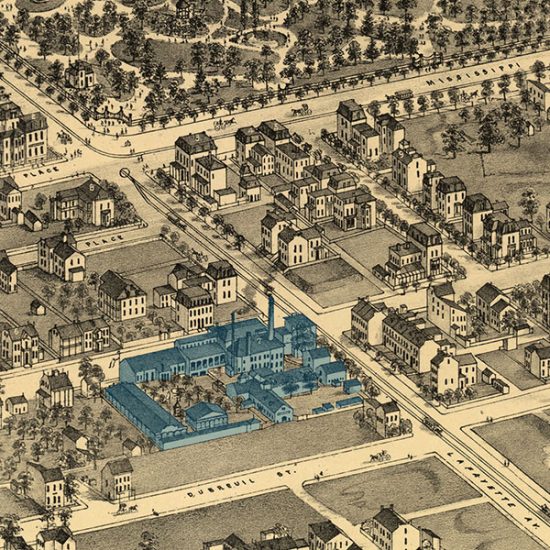
That brewery is Joseph Schnaider's Chouteau Avenue Brewery. Once located at the intersection of Chouteau Avenue and Twenty-First Street, it was one of the most successful St. Louis breweries in the in the 1870's. In 1876, Chouteau Avenue Brewery ranked among the top three local breweries in capital stock, annual value of business, number of barrels produced, number of employees on hand, and number of horse wagons used. Today, no trace of the brewery exists except for one building.

It's founder, Joseph Maximillian Schnaider, was born in Zell am Hammersbach, Germany in 1832. A brewer by trade, he settled in St. Louis in 1854. At first, he co-owned a successful brewery named the “The Green Tree Brewery”. In 1865, he sold his interest to his partner and set off on his own. Shortly after, he opened Chouteau Avenue Brewery just west of the city.

The story of Schnaider's brewery isn't much different from the other St. Louis breweries of the day. What makes it unique is the beer garden he built next to it. Covering several acres, Schnaider's Beer Garden served food and drink to thousands of people at once. At its height, it became a nationally known resort where visitors could enjoy music, watch theater, and of course, drink beer.

Entrance to Schnaider's Beer Garden

The northern half of the brewery complex can be viewed in the upper left corner of plate 40 in Compton & Dry's Pictorial St. Louis.

1875 Pictorial St. Louis - Plate 40

By lining up plates 39 and 40, the full extent of the beer garden can be seen. The main brewery is located in the upper-right edge of the complex (labelled “1″). The rest of the property contained an auditorium, pavilions, plenty of shade trees, gazebos, and other structures used to entertain the large crowds that would pack Schnaider's each day.

1875 St. Louis Pictorial - Plate 39 & 40 - Combined

Across the street from the brewery is a structure that no longer stands. It was demolished and Schnaider's Malt House was built there in 1876 (one year after the publication of Compton & Dry's Pictorial St. Louis).

1875 St. Louis Pictorial - Plate 40 - Closeup

Schnaider's Beer Garden became a nationally known venue. Bands, theater groups, and travelling shows performed nightly during the summer months. According to the book St. Louis Brews: 200 Years of Brewing in St. Louis, 1809-2009, Schnaider even created his own light opera company to compete with a local baseball team, the St. Louis Brown Stockings. The success of the Brown Stockings (later to be known as the Cardinals) was drawing patrons away from his beer garden and eroding his profits. It's also believed that some of the musical groups that played Schnaider's would eventually combine to form the St. Louis Symphony Orchestra. To promote Schnaider's, schedules, advertisements, and reviews for performances such as “The Pirates of Penzance” and “The Beggar Student”, were published daily in local newspapers.

Schnaider Bands

Behind all the entertainment, Schnaider's served beer… enormous quantities of beer. Thousands of people would fill Schnaider's Beer Garden each day to eat, drink beer, and celebrate. They'd make toasts, smoke cigars, and watch fireworks displays as music and theater swirled around them. With such revelry, it's not surprising things would sometimes get a little out of hand. One notable example was reported by the St. Louis Post-Dispatch in August, 1881. A young man “under the influence of liquor” visited Schnaider's Garden and promptly began throwing tables and chairs around. When waiters intervened and called the police, the man simply claimed “Oh, that's nothing! We do that kind of thing in Philadelphia and never think anything about it”.

The next morning, he found out things work a bit differently in St. Louis. A judge fined him ten dollars.

Schnaider Pavilions

Joseph Schnaider died in 1881 while visiting his homeland. His wife and oldest son took control of the brewery and continued to expand operations. Over the next ten years, several buildings were added to the complex, including an ice house, a machine house, a storage house, a bottling house, and a summer theater. By 1885, Schnaider's would be one of the largest breweries in St. Louis.

Schnaider's Beer Garden

Despite growth and the splendid reputation of garden, Schnaider's wouldn't last long. In 1889, eighteen St. Louis breweries were consolidated under one company, the St. Louis Brewing Association. Although breweries such as Lemp and Anhueser-Busch opted not to join the syndicate, Schnaider's Brewery did.

Over the next few years, the SLBA began consolidating and closing down member breweries one by one. Schnaider's continued operations for a few years, but the beer garden slowly began to lose its allure. New musical venues and entertainment establishments opened around the city, drawing patrons away. In 1893, the brewery was closed and the beer garden abandoned. The main brewery buildings were converted to a cold storage and ice plant. The beer garden structures were razed to make way for a large shoe factory. The Schnaider Malt House, located across the street, is the only building that still stands today.

Schnaider's Beer Garden

Today, the “Centennial Malt House” (as it is now called) stands at 2017 Chouteau Avenue. In 2005, the building was purchased by Wendy and Paul Hamilton. They quickly went to work on an impressive $4 million restoration project. Across the street, the former site of the beer garden is now where several attractive row houses stand. These homes, located at the northern end of the Lafayette Square neighborhood, set a good example for effective urban development in St. Louis.

Schnaider's Malt House is significant because it is was one of the first malt houses to be constructed in St. Louis. Designed by Fred W. Wolf, a Chicago engineer, and Louis Kledus, a St. Louis architect. Wolf was a prominent brewery engineer of the time. The Schnaider Malt House is one of his earliest designs and one of just a handful that still stand today. Today, the building is on the National Register of Historic Places.

Schnaider's Today

The Drink

The Centennial Malt House offers a variety of dining and drink options. The first floor contains PW Pizza, a great place to drink local beer and eat pizza made with fresh ingredients. Moulin, on the second floor, can be rented for special events and meetings. The third floor contains the rooftop bar and bistro, Vin de Set. There's also a small market and culinary store on the first floor named Grand Petite Market. The Malt House Cellar, which once granted access to the underground caves, is also used for private events. Overall, it is an impressive renovation of a historic building.

Vin de Set

After thinking and writing about Joseph Schnaider and his brewery for over a week, I'm elated that I can get a drink in the actual building that I'm writing about. It's a first for this blog. Even better, Vin de Set is exactly the kind of place where I like to get a drink. Although it has a nice rooftop seating area, the bar inside is even better. The lighting is great, the staff is extremely friendly, and the brick and woodwork make for a great atmosphere. It's obvious the history of the building was important to the designers.

The first thing a visitor sees when entering the bar is a familiar statue. It's a smaller version of “Apotheosis of St. Louis”. The full-size version of this statue is a symbol of St. Louis city and stands in front of the St. Louis Art Museum. While at Vin de Set, I was told this smaller version was presented to Schnaider's as a gift to commemorate the 1904 World's Fair. Years later, it was found stored away in the Malt House missing its head and sword. It has since been restored and now sits impressively above the bar.

My drink of choice at Vin de Set was an Old-Fashioned cocktail. Made with a spirit, bitters, simple syrup, muddled fruit (and sometimes club soda or water), the Old-Fashioned is one of my favorites. I plan to write more about the history of this drink in its own post . I've been told it's considered an “old man drink”, so it's appropriate that I'm in an old building (but at 41, not yet an “old man”). Even better, the bartender made a good one. He made it with rye whiskey, which I was happy about since I did not offer any instruction. Some Old-Fashioned drinkers eschew the fruit, but like the history of the drink, I'll save that argument for a future post. For now, I'm happy to have rye whiskey in my Old-Fashioned.

Since Vin de Set also offers a full menu, I'm sure I'll be heading back to take in a bit more of the Schnaider ambiance.

divider

Notes: The original idea for this post came from Andy Hahn, the Director of the Campbell House Museum. One day he mentioned a “beer garden that could hold thousands”, and it caused my eyes to light up. Much of the information for this post was obtained courtesy of Landmarks Association of St. Louis. The renovation of the Joseph Schnaider Malt House was on their list of “Eleven Most Enhanced Places” in 2006. Photographs are courtesy of the Missouri History Museum. The book St. Louis Brews: 200 Years of Brewing in St. Louis, 1809-2009 by Henry Herbst, Don Roussin, and Kevin Kious also provided quite a bit of information. Anyone who is interested in the history of beer in St. Louis should own that book.

October 12th, 2012 by Cameron

The (Almost) Civil War Bicycle Tour of St. Louis

The Civil War in St. Louis

I am a big fan of travel writing. I like to read about the different perspectives and experiences offered by people who seek out hidden corners of the world. Travelogues often contain a great amount of historical discovery. Guys like Paul Theroux and Simon Winchester write great books that see back in time. A few years ago, a good friend told me that I should read A Walk in the Woods: Rediscovering America on the Appalachian Trail by Bill Bryson. The book tells the story of his attempt to hike the entire 2,000+ miles of the Appalachian Trail in one shot.

Bill Bryson is a great writer. He is brilliant and extremely funny. He’s an American, but he lived in England for twenty years. His book about hiking the Appalachian Trail was an attempt to rediscover America after moving back to the states. Recently, Bryson has ventured into other areas of study such as science (A Short History of Nearly Everything) and history (At Home: A Short History of Private Life). I’ve read many of his books, and I’ve enjoyed all of them.

Well, except for A Walk in the Woods.

Actually, maybe I shouldn’t go that far. I enjoyed much of the book. It’s funny and insightful. Bryson has a great ability to describe his encounters with bears, bizarre characters (like the noteworthy “Chicken John”), and the trail itself. He provides history of the trail and he makes a strong plea for conservation while he’s at it. His partner on the hike, a former drug addict named simply “Katz”, is the perfect comedic sideshow to the story. But here’s my issue (spoiler alert!): They didn’t finish the hike. After months of bugs, bears, turmoil, and mayhem, the two decided to quit and go home. I can’t deny that I had a bad taste in my mouth as I read the final pages.

A Walk in the Woods

So, why am I even talking about Bill Bryson? Why mention him in a blog post titled “The (Almost) Civil War Bicycle Tour of St. Louis”? It’s because on a far smaller scale, I may have found my reason to cut Bill Bryson a little slack.

Here’s what I had in mind for this blog post. Recently, I discovered the Missouri History Museum released a mobile app named “The Civil War in St. Louis”. It’s free, and I highly recommend it to anyone who would like to get out and see some historical locations in St. Louis relating to the Civil War. The app focuses on a “primary” tour containing twenty sites. The app provides directions, maps, photographs, descriptions, and even an audio narrative to listen to at each stop. The app also contains several “secondary” locations that are notable, but not included in the main tour.

I haven’t worked the Civil War into this blog so far, so I thought this would be a perfect opportunity to do so. Even better, I came up with a plan to do the entire tour by bicycle in one day. It’d be a perfect opportunity to get a long ride in, learn some Civil War history, and of course, get some drinks along the way (well, it is Distilled History, after all). Hitting all twenty sites in one shot would present me with a bike ride of about fifty-five miles. Throw in some history, and that’s a fun day.

The app is based on a book I am already familiar with: The Civil War in St. Louis: A Guided Tour, by William C. Winter. St. Louis played a huge factor in the Civil War, so I was really excited to get this day going. Just glancing at the list of sites, I knew I was going to learn a few things. I know nothing about Brant Mansion, Berthold Mansion, or Myrtle Street Prison. Others I know well, like the Eugene Field House, Lyon Park, and Stifel’s Brewery. A few of the sites will eventually get their own post in this blog, such as Camp Jackson and Lynch’s Slave Pen.

So there’s my plan. Follow along as I provide the commentary of my day. I realize I’m no travel writer, but I think it’s about as close as I’ll ever get to doing something like documenting a hike of the Appalachian Trail.

Ruby & I

My plan was to park near the first stop (the Old Courthouse), but I quickly realized I picked the absolute wrong day to do this tour. There’s a Cardinal playoff game going on at Busch Stadium. This means I’m kidding myself if I think I can park downtown. I’m also surrounded by a sea of red. It’s about an hour before game time, so the sidewalks are packed with Cardinal fans milling around. As I begin my tour, I’m slightly annoyed.

Map to Stop #1

I find a parking spot several blocks away and I bike to the first stop of the tour. When I get to the “Stop #1″ marker on the iPhone map, I’m facing the Old Courthouse on 4th and Market. I play the audio tour through the app and I hear the story of Dred and Harriet Scott.

Anyone who doesn’t know about Dred Scott surely slept through history class. History is probably the only class I didn’t sleep through, so I think it’s great that I live in a town with ties to this guy. In 1846, it was in this courthouse that Dred and Harriet began the fight to get their freedom. After years of trials and appeals, the case would eventually reach the United States Supreme Court. The verdict would be a divisive moment in the years leading to the Civil War. Today, the Old Courthouse is one of the iconic structures in St. Louis and is currently going through some renovations. A nice statue of Dred and Harriet sits on 4th Street facing the Gateway Arch.

Dred Scott’s story in St. Louis is definitely something I plan to write about in the future, so I won’t say any more. Time to head to the second stop of the tour.

Stop #1 - The Old Courthouse #1

Stop #2 - The Old Courthouse #2

The second stop of the tour is on the other side of the Old Courthouse, so I simply just walk around the block. I’m facing the building from the Broadway side. There are tons of Cardinal fans here. I’m in full bike gear and scalpers are trying to sell me tickets. Really?

map_stop02

The app plays and tells another story of the Old Courthouse. The front steps of the Old Courthouse were once used for slave auctions in St. Louis. At the time of the Civil War, St. Louis was largely a pro-Union city in a slave state. The audio commentary tells the story of a slave auction that occurred here on January 1, 1861. At this sale, a group of anti-slavery protesters disrupted the proceedings by continuously making low-ball auction bids. Eventually, the slave dealers became frustrated and left. I think that’s pretty great story and I’m happy to learn about it. Time to head to the third stop.

Stop #2 - The Old Courthouse #2

The app now directs me to another corner on the same block. I simply walk over and face the corner of northwest corner of 4th and Chestnut. Except for the short ride to the first stop, I haven’t even gotten on the bike. This is pretty easy tour so far.

Map to Stop #3

This is the former site of the grand Planters House Hotel. Nothing remains of it today, but it was once one of the most lavish and famous hotels in St. Louis. Celebrities, dignitaries and politicians were frequent guests. I’ll also give a plug to the Campbell House Museum and mention it was also the home of Robert and Virginia Campbell after they were first married. I play the audio commentary, and it tells me a story I’m familiar with. In June 1861, this is where a famous meeting between the pro-Confederate Missouri Governor Claiborne Jackson and Union leader Nathaniel Lyon occurred. They met to discuss the fate of Missouri in the coming conflict.

History tells us that meeting didn’t go very well. To sum it up, at one point Lyon famously stood up and proclaimed “This means war!” before storming out. Whew. That’s not good.

Three stops down and seventeen to go.

Stop #3 - The Planters House Hotel

For stop four, I’m directed to the northwest corner of Pine and Broadway, just a couple blocks south of the Old Courthouse. It’s the former site of the Berthold Mansion. I had to weave through several Cardinal fans, but I barely needed to clip into my pedals. One group of people liked the University of Dayton sweatshirt I had on (I’m an alum), so I received a series of fist-bumps. Strangely, that was about the only human interaction I had during the tour (other than the bartenders I’d soon be ordering from, of course).

Map to Stop #4

I’m actually not familiar with the Berthold Mansion. The app tells me that at one time, it was the stronghold of a group of pro-Confederate men in St. Louis who called themselves “The Minutemen” (hey, that’s original). One day in early 1861, these guys raised a secessionist flag over the mansion, enraging Union supporters in St. Louis. The Confederate flag had yet to be designed, but this was actually one of the first southern flags to fly in Missouri. It an example of the deep rift that existed among certain groups of St. Louisans leading up to the war. Actually, I’m realizing that is the primary theme of the tour. St. Louis was a divided city during the Civil War, and it the atmosphere was tense.

Stop #4 - Berthold Mansion

Next, I’m led about two blocks south 510 Locust Street. I’m now facing the current Mercantile Exchange Building. The app tells me it is the former location of the St. Louis Mercantile Library. According to Winter’s Civil War book, the Mercantile Library is still open, but that’s obviously not the case. The app sets me straight and tells me the library has recently moved to the University of Missouri-St. Louis.

Map to Stop #5

When I listened to the audio commentary, I had my first “No shit?” moment of the day. I learned the Mercantile Library first opened in 1854. The building was three stories tall, and the Grand Hall on the third floor was the largest assembly room in St. Louis at the time. In 1861, that hall was the location where a group of state delegates met and voted to keep Missouri in the Union. I never knew this was the location where that went down. I love learning history tidbits like that.

Even better, I then learned that the assembly hall is also where the Missouri Emancipation Ordination was adopted in 1865, officially freeing all slaves in the state. Again, I find myself saying “No shit?”.

Stop #5 - The Mercantile Library

Finally, I get to ride for a few miles. Stop #6 is Lyon Park, a location I know well. It sits directly to the east of the Anhueser-Busch (ahem, InBev) Brewery on South Broadway. South Broadway is a great street to ride a bicycle on. It’s wide, has bike lanes, and it goes through great neighborhoods. There is history all around.

Map to Stop #6

The park is named for Union General Nathaniel Lyon. A large statue of him sits at one corner of the park. It was also the site of the United States Arsenal during the time of the Civil War. It was here that Lyon organized his troops to march on the Confederates camped at Camp Jackson on the western edge of St. Louis. The result would be one of the most dramatic events in St. Louis history. As I mentioned earlier, Camp Jackson will definitely get its own post in Distilled History at some time, so I won’t go into further detail here.

Stop #6 - Lyon Park

Time to get a drink. Heading back north on Broadway, I turn into Soulard and stop for a couple at 1860 Saloon. Obviously, I pick this place simply for the name.

Map to Drink Stop #1

The next stop takes me back north. Here’s my first indication that the Missouri History Museum didn’t design this tour for bicyclists. Or maybe they didn’t mean for it to be done all in one shot? Stop #7 brings me back to almost exactly where the tour started. In addition, I’m passing stops that I know I have to visit later on. Fortunately, I like bicycling.

Map to Stop #7

I’m on the riverfront just north of the Martin Luther King bridge. In the fall of 1863, a man named Frank Martin was fishing from a small boat here on the river. He witnessed several men lighting a nearby steamboat on fire. The fire spread to two other steamboats before being extinguished. According to the audio commentary, this became a common practice in the next few months. It seems lighting steamboats on fire became a common way for pro-Confederates and pro-Unionists to piss each other off. When arson starts happening, you know you are in a divided city.

Stop #7 - Steamboat Fires

The next stop sends me south to another point on the riverfront. I’m now directly in front of the Arch, but facing east, looking over the river. I passed right by this stop to get to the other riverfront stop. Sigh.

Map to Stop #8


When I play the audio commentary, I hear a pretty cool story. At this location in 1863, twenty-one people were huddled aboard a ship named the “Belle Memphis”. Accused of being southern sympathizers and spies, these men and women were being banished from St. Louis. The ship took these people down the river to a port in Tennessee and simply dumped them off. One woman was included in this group simply for writing a letter to her husband in the Confederate Army. They were forced to make their way in a new city. Most would never return to St. Louis.

Stop #8 - Banished Southern Sympathizers

For the next stop, I head back north and west into downtown. I’m backtracking again. I pass by Lumière Casino, which makes me cringe. It’s the biggest eyesore on the riverfront. It doesn’t help that I’d rather be dragged over broken glass than spend time at a casino.

Map to Stop #9

When I get to the next stop, I’m at the corner of Washington and Tucker. In 1864, this was the northernmost point of the Mississippi Valley Sanitary Fair. I have read about this event, but I don’t know much about it. The app fills in some gaps. During the war, St. Louis was overcome with illness, severe injury, and death on a scale never before experienced. The fair was a fundraiser organized by Union supporters in order to raise money for U.S. soldiers and the families they left behind. It brought in a profit of $500,000, medical supplies, and much-needed relief to city that needed it. According to the app commentary, this fair attracted visitors from all over the country.

Stop #9 - Mississippi Valley Sanitary Fair

The next two stops are actually both at the same place. I’m directed south to the intersection of Broadway and Clark. It’s located right next to Busch Stadium. The baseball game has started, but I still had to deal with traffic and tons of Cardinal fans as I make my way to the stop.

Map to Stop #10

Back in the Civil War era, this was the corner of Myrtle and 5th. It was the site of business for Mr. Bernard Lynch, a successful slave dealer. At this corner, in the shadow of the present-day Busch Stadium, a large slave pen existed. Even worse, it was notable for containing children. At this site, children as young as five years old were held and auctioned off.

In 1861, Union soldiers seized Lynch’s Slave Pen and converted it to Myrtle Street Prison. The audio commentary then tells me about one of the famous inmates of Myrtle Street Prison. During the 1850′s Colonel “Doc” Jennison and his men (called “Jayhawks”) terrorized and looted towns along the Missouri-Kansas border. His imprisonment sparked controversy in St. Louis because many in town considered him a faithful Unionist and proud supporter of abolition.

Today, the factory that makes Tums antacid tablets is located here. It’s also filled with tons of ticket scalpers on game day.

Stop #10 & #11

The app then directs me south to the Eugene Field House. I’m curious because Eugene Field really had nothing to do with the Civil War. It’s a great historic home, but Eugene Field barely lived here. And what’s the deal with the toy museum? He was a poet. My beloved Campbell House should be on this tour before Field House is. Also, why didn’t the app stop me here when I passed it on the way to Lyon Park?

Map to Stop #12

Anyway, the Eugene Field House is located at 634 South Broadway. It was part of “Walsh’s Row”, a series of brick houses built in 1845. The Eugene Field House is the only one that remains. Fortunately, I’m pleased that to hear that its inclusion in this tour is due to Eugene’s father, Roswell Field. In 1853, it was Roswell Field who brought the Dred Scott case to the Supreme Court. His reputation and legacy would forever benefit from that case.

Stop #12 - Eugene Field House

Time for another drink stop. This place has been mentioned before in my blog post about Compton & Dry. It’s next to Field House and it’s empty, so it’s a good place to take a breather. All the Cardinal fans are at the game, so I have the outdoor garden to myself. The weather is great, so I sit outside and have a couple of beers.

Map to Drink Stop #2

First of all, I finally learned how to pronounce this street. It’s pronounced “Grash-ut”. It’s not a commonly referred to street in St. Louis, but I always assumed it was pronounced “Grat-ee-ot” or something odd like that. I could do an entire blog post about how St. Louisans pronounce their streets. Seriously. I think I may have to do that.

Map of Stop #13

I’m now at the intersection of Chouteau and 8th. This was the location of the Union-run Gratiot Street Prison. It was smack in the middle of one of St. Louis’s wealthiest neighborhoods at the time. Twelve-hundred prisoners were first incarcerated here on Christmas Eve in 1861. Prisoners included men, women, and children. If you broke the law in St. Louis, you were likely headed to this overcrowded and filthy prison.

Today, it’s the entrance to Purina Corporation’s parking lot.

Stop #13 - Gratiot Street Prison

Here’s where the bike riding starts. I know the location of Camp Jackson well, so I hop on the bike and head west towards St. Louis University. I get to the corner of Grand & Lindell and walk through campus.

Map to Stop #14

This area was once the outskirts of St. Louis. The area was called “Lindell Grove”. The app tells the story of Camp Jackson, which is also discussed at the Lyon Park stop. Anyone who is interested in the Civil War in St. Louis needs to know about what went down during the Camp Jackson affair. Some even refer to the event as the “St. Louis Massacre”. It’s easily the most significant even in St. Louis during the Civil War. It’s also too big of a deal to discuss here, so look for a future Distilled History post about it.

Surprisingly, there’s a plaque here providing some historical information about Camp Jackson. Usually, if there’s anything historically significant near St. Louis University, it gets ripped down. Father Biondi must have missed this.

Stop #14 - Camp Jackson

Here’s a lengthy ride into north St. Louis. Unlike some people, I love biking in north St. Louis. I love to see the architecture and think about how things have changed in this city. Even better, Benton Barracks was where Fairground Park is now located. There is great history in this part of town. You can get worked over in this part of town if you aren’t careful, but I’ve never had an issue.The app tells me to go to the western edge of the park at the corner of Natural Bridge and Fair.

Map to Stop #15

I don’t know a ton about Benton Barracks, so I’m excited to hear what the app tells me. This is where Union soldiers encamped and trained in St. Louis during the Civil War. It was built on 150 acres of land owned by John O’Fallon, a prominent St. Louisan at that time. The app also tells a humorous story about a man who refused to move off the land to make room for the camp, so the army made him a chaplain. He was an atheist, but the new gig allowed him to stay put.

Stop #15 - Benton Barracks

The tour is now sending me all the way back into south city. This is a perfect time to stop and get a drink. On my way south, I take a detour into Lafayette Square and get a beer at Square One Brewery. St. Louis has recently exploded with several great microbreweries, and Square One is a good example. They serve good craft beer here.

Map to Drink Stop #3

I’m now heading to the intersection of Indiana and Shenandoah in south city. This could have been placed right after the Gratiot Street Prison stop. There doesn’t seem to be any timeline to the tour, so why are the tour stops spread out all over the place?

Map to Stop #16

This area is the former location of Fort No. 4, one of a serious of fortifications that existed around St. Louis. The app then tells me the story about a pretty significant event that happened here. In 1864, a crowd of 3,000 people gathered here to watch the execution of six Confederate soldiers. The execution was part of a grizzly act of retribution ordered by Union command. Six Confederate captives were picked at random and shot. Today, their graves can be found in a single row at Jefferson Barracks.

Stop #16 - Fort No. 4

If you notice, I seem to have skipped stop #17. That’s because this is my Bill Bryson moment. Stop #17 is supposed to send me to the U.S. Grant National Historic Site. Located west of the city, bicycling there and back would add about twenty-five miles to the tour. It’s getting late and there is simply no way I’m doing that. I’m not even giving it a second thought. Maybe that’s what went through Bill Bryson’s head as he looked at his itinerary: “No way. I’m going home”. Furthermore, it’s not like I’m writing a book about this. It’s a simple blog post. Grant is getting skipped.

Well played, Mr. Bryson. Well played.

Still, I have to head back into north city to get to stop #18. Why wasn’t I directed there after Benton Barracks? I’m tired of riding through downtown St. Louis.

Map to Stop #18

Eventually, I get to the corner of Howard and 14th just north of downtown. It’s hard to believe a large brewery once stood here. At the time of the Civil War, this was the site of a brewery owned by Charles Gottfried Stifel, a German who came to St. Louis in 1849. In 1860, Stifel bought twenty-five muskets and began drilling other German Unionists in the malt house of his brewery. Pro-Unionist Germans in St. Louis signed up with Stifel’s militia in large numbers. A year later, his force of 1,000 men were ambushed by secessionists in downtown St. Louis. The conflict would leave eight St. Louisans dead.

Stifel will definitely get his own place in Distilled History, so I won’t say much more now. In addition, I’m antsy to close out this tour.

Stop #18 - Stifel Brewery

label_stop19

Stop #19 directs me back south. Of course, I’m heading right back to a part of town I’ve been to twice already. This is insane. I’m too tired to even stop for a beer. I need to get this thing over with.

map_stop19

Still, I know nothing about Brant Mansion. I’m pleasantly surprised about what I hear from the audio commentary at this stop. For a few months in 1861, this house was the Union headquarters of John C. Frémont. I actually wrote a paper about John C. Frémont in college, so I’m kind of pissed at myself for not knowing about this house. The story of Frémont is good. He angered Abraham Lincoln early in the war when he put Missouri under martial law and then threatened to free Missouri slaves. When Lincoln overruled him, his wife even traveled to Washington to plead his case. In the end, Frémont learned you don’t cross Abe. Soon after, he was looking for new work.

civilwartour_stop19

label_stop20

Finally, the final stop. It’s sends me back into downtown. The final stop is St. John’s Apostle and Evangelist Church located on Plaza Square. It’s about a mile away.

map_stop20

I often mention this church during tours at Campbell House Museum. It’s one of the few remaining structures in that area that were built prior to the war and still exist. Interestingly, this church was funded by donations from a Confederate militia. The priest, John Bannon, was a Confederate soldier. As a result, he was targeted by Union supporters. He had to disguise himself in order to escape out the back of his church and find protection outside of St. Louis.

civilwartour_stop20

label_stop17

I skipped it, but I decided that I should at least drive out to White Haven and complete the tour. I bike back to the car and load it up. I then head to the U.S. Grant National Historic Site west of the city. When I get there, I’m confronted with big, white, closed metal gates. It’s after 5 p.m. and I realize the place is closed. I’m elated! If I had biked twelve miles to find myself staring at a closed gate, I would have lost my mind.

map_stop17

Most St. Louisans are familiar with White Haven. It’s one of two structures still standing in St. Louis that Ulysses S. Grant lived in. Grant first visited White Haven after he graduated from West Point. He came to White Haven to visit the family of one of his fellow cadets, Fred Dent. While there, he’d meet Julia Dent, his future wife. What’s even more interesting is that the Dents were slave owners. The man who would lead the Union Army and help free the slaves married into a family that had eighteen of them.

civilwartour_stop17

The Drink

So there’s the tour. Twenty sites and about twenty-nine miles on the bike. I headed back home and enjoyed a Hendrick’s martini on my porch to close out the day.

In closing, I would like to add that the Missouri History Museum really put together a great mobile app. Even though I whined about the route, it was a fun day. Many of the “then” images used in this post are directly from that app, so they get the credit all around. I purposely skipped a bunch of information revealed in the app, so I recommend other St. Louis history nuts check it out and maybe visit a few sites. It’s definitely a neat experience to stand at the same sites where history happened.

Last but not least, get over and see the Museum’s exhibit about the Civil War in Missouri before it closes. It’s very impressive.

Finally, during my route, I took a hand-held GPS with me that tracked my route. The crazy map below shows why I’m now ready to show a bit more appreciation for Bill Bryson and his desire to simply go home.

Civil War Bike Map


September 21st, 2012 by Cameron

Gin and Drugs, My Dear, Gin and Drugs

T.S. Eliot

In his masterpiece The Waste Land, T.S. Eliot begins with the famous line “April is the Cruellest Month”. What follows is generally regarded as one of the most important poems of the 20th Century. When T.S. Eliot published his influential work, it was 1922 and he had been living in London for several years. He was far removed from his youth growing up in the  gritty neighborhood on the western edge of downtown St. Louis.

For that reason, I’ll forgive him for overlooking August in St. Louis, which to me is far crueller.

But T.S. Eliot wasn’t writing about humidity and how ridiculously hot it gets in this town. He may have been alluding to the prologue of Geoffrey Chaucer’s The Canterbury Tales. He turns it on its head, informing the reader that The Waste Land will be a far darker reading experience.

Personally, I’ve read The Waste Land twice. The first time was about twenty years ago when it was assigned in college. The second time was a few days ago when I realized I was about to write a blog post about T. S. Eliot.  On both occasions, getting through it was no easy feat. The Waste Land changes voices and locations constantly. It contains lines in German and mantras in Sanskrit. It alludes to Homer, the Bible, Aldous Huxley,  Sophocles, Dante, and even Buddha. I won’t pretend to offer insight into its meaning or explain it’s purpose. Just take my word for it. The Waste Land is a momentous achievement. Read it and it’s impossible to not admire the beauty of Eliot’s prose.

The Waste Land

Many haven’t read him, and I’d venture to guess that many more bend the truth and say they have. But find me a person who hasn’t at least heard of T.S. Eliot. Pull up any list of the great poets, and it’s likely his name is on it somewhere. For that reason, it has always surprised me T.S. Eliot is not more recognized in the city he was born and raised in. Eugene Field’s boyhood home in St. Louis is a museum. He lived in St. Louis less than ten years. Scott Joplin’s home is a state historic site. He lived here less than seven.

T.S. Eliot’s time in St. Louis was not a flash in the pan. He was born at 2635 Locust Street in St. Louis on September 26, 1888. He was raised and spent his formative years here until leaving to be educated at Milton Academy and then Harvard. His family was well established in St. Louis. His grandfather was William Greenleaf Eliot, a prominent St. Louisan and co-founder of Washington University.

Recently, I took another great bicycle history tour sponsored by the good people at Trailnet. This one led us up and down Locust Street on the western edge of downtown St. Louis, an area that was once referred to as “Automobile Row”. The area has that nickname because of the large amount of automobile dealerships, showrooms, parts stores, and automotive businesses that once existed there. Another post may be coming about that topic at some point, but Trailnet promoted this tour by claiming we’d see “one of the most overlooked historical locations in the midwest”.  The tour was led by Harold Karrabell, a man  who previously led me on Trailnet bike tours of Cahokia Mounds, East St. Louis, and Carondelet.  As I mentioned in a previous post about the Jacob Stein House, Mr. Karabell has an impressive knowledge of the history of St. Louis. His tours are well-researched, well-organized, and informative. Even better, he prefers to lead these tours while riding a bicycle. And once again, Harold didn’t disappoint. As we rode east along Locust Street, we slowed as we approached the Jefferson Avenue intersection. Harold stopped us in front of a parking lot and pointed out a large plaque on the sidewalk.

T.S. Eliot Plaque at 2635 Locust

The plaque identifies the location of the home where T.S. Eliot was born and raised. My jaw dropped when I saw it. Over the years, I have ridden or driven past this location hundreds of times. I simply never knew it was there. I had always heard Eliot lived in Central West End, not in the sketchy outskirts of downtown St. Louis. I simply love historical markers such as this. Some people prefer to only see historical places that still exist, but that’s not me. I enjoy seeing places that have changed and thinking about why they did. Why was T.S. Eliot’s home razed and turned into a parking lot? What did the neighborhood look like when he lived there? When T.S. Eliot lived at 2635 Locust Street, the population of St. Louis was almost 700,000. In Eliot’s day, the street was likely teeming with activity. Today, the neighborhood shows no sign of once being a residential neighborhood. Fortunately, one building still stands that can give us a frame of reference between then and now.

2635 Locust - H.W. Eliot Home - Then & Now

At the time Eliot lived there, Locust Street was a neighborhood in transition. Once residential, saloons and factories started popping up, making it a rougher part of town. Although the Eliot family was wealthy, they remained in the neighborhood during it’s decline because of family that lived nearby. In 1905, the family moved to a new home in the prosperous Central West End. Although this home still stands today as a private residence,  T.S. Eliot lived here for less than a year before heading off to school.

4446 Westminster Place - H.W. Eliot Home - Then & Now

After graduating from Harvard, Eliot moved to London in 1914. There he met the poet Ezra Pound, a man who would have a profound impact on his writing and career. Pound helped Eliot get his poem The Love Song of J. Alfred Prufrock published in 1915. The success of Prufrock marked the beginning of Eliot’s career as an influential poet.  Along with The Waste Land, Eliot would publish several noteworthy poems such as The Hollow Men (1925), Ash Wednesday (1930), and Four Quartets (1945), each of which earned him critical acclaim and recognition. He also gained renown as a playwright and a literary critic.  In 1939, he published a book of poems named Old Possum’s Book of Practical Cats, which became the basis for Andrew Lloyd Webber’s musical Cats. In time, he’d be recognized as one of the most important poets of the 20th Century. To honor of his impressive body of work, he was awarded the 1948 Nobel Prize for Literature.

 In 1929, Eliot converted to Anglicanism and became a British citizen. He lived the rest of his life in England, but he never forgot the influence St. Louis had on him. Later in life, he spoke about the impact of  growing up in a river town. He fondly recalled going down to Eads Bridge to view the Mississippi when it flooded. He believed people who grew up in a river town understood rhythm more than people who didn’t. In The Four Quartets, he writes about a river in this notable stanza:

The Four Quartets

T.S.EliotEliot did return to his hometown on a few occasions. In 1953, Eliot returned to speak at the celebration of Washington University’s 100th anniversary. In his speech, Eliot expresses his feelings about growing up in St. Louis:

“Many other memories have invaded my mind since I received the invitation to address you today. But I think these are enough to serve as a token of my thoughts and feelings. I am very well satisfied to have having been born in St. Louis. In fact, I’d even say I think I am fortunate to have been born here rather than in Boston, or New York, or London.”

T.S. Eliot died of emphysema on 1965. His ashes are interred at St. Michael’s Church in East Coker, Somerset.

In closing, can we get a street or something named after this guy? As of now, the extent of T.S. Eliot’s recognition in St. Louis doesn’t go beyond a few plaques and a small bust in the Central West End. How about a park or a library? His grandfather has one of the Ittner schools named after him. It’s time St. Louis gave T.S. his due.

Harold Karabell & I on the Automotive Row Trailnet Ride

The Drink

Initially, I planned to get a drink at the closet location possible to T.S. Eliot’s plaque on Locust Street. This worked out pretty well, because that meant I’d be heading to the Schlafly Tap Room, located just a couple blocks to the east. Even better, Schlafly was hosting their annual “Hop in the City” beer festival on the same day Harold showed us the plaque. Since I already had a ticket, it seemed like a perfect fit.

That is, until I read about an exchange T.S. Eliot had with an admirer in the 1950′s. The person asked him about the source of his inspiration. His reply quickly changed my mind.

Gin and drugs, my dear, gin and drugs

Imagine my joy when I found out T.S. Eliot drank gin. Although the Manhattan is my favorite cocktail, gin is very dear to my heart. The gin and tonic is probably my standard drink to have on the porch after a long day at work. I also love martinis. After reading his response,  I started hunting around for more clues about T.S. Eliot’s drinking preferences. The news only got better. I found out he had a cat named “Noilly-Pratt” after the French vermouth brand. In the Letters of T.S. Eliot, he explains how he wrote the monologue to the verse drama Sweeney Agonistes: “I wrote it in three quarters of an hour after church time and before lunch one Sunday morning, with the assistance of half a bottle of Booth’s gin.”. Finally, I found this quote:

Martini Quote

With that, there leaves no doubt that a martini is the drink for a T.S. Eliot blog post. Located just a few blocks west of T.S. Eliot’s boyhood home at 3037 Locust is the Fountain on Locust.  The window of this restaurant advertises ice cream and retro cocktails. It’s a neat place with a fun and colorful decor inside. Their specialty is the “Ice Cream Martini”, and the drink menu has a full-page of varieties. I’m not an ice cream and alcohol kind of guy, so I went for the standard dry martini. The selection of gin at Fountain on Locust is a bit weak for a place advertising retro cocktails, so I the best I could get was Bombay Sapphire. Nothing against Bombay, but I was hoping to get something special like Plymouth or Broker’s.  To my delight, the bartender made me an excellent martini. If it had any vermouth in it, it was probably the same amount my father used when he taught me how to make a martini: Open the vermouth bottle and just wave your hand over it a couple of times. And to top it off, it was wonderfully stirred. I can’t abide a shaken martini. Damn you James Bond! I like to think T.S. Eliot wouldn’t put up with that, either.

The Fountain on Locust

September 10th, 2012 by Cameron

The St. Louis Motordrome

St. Louis Motordrome Racer Wells Bennett - Photograph by J.R. Eike, courtesy of Thomas Kempland

One of the joys of starting this blog is how I sometimes just bump into the hidden past of St. Louis. These days, when I bike to work, drive around, or explore new parts of the city, I’m always on the lookout for something new. This city is filled with history. As a result, I have started filling up notebooks and blog drafts with ideas and topics that I plan to investigate at a later date.

Recently, I found records of a St. Louis structure that I had never heard of before. I was clicking through some St. Louis websites looking for ideas, and I stumbled upon a webpage filled with a fascinating collection of old photographs.

The collection contains about 100 photographs taken by a man named J.R. Eike between the years 1914 and 1917. They come from a collection of glass plate negatives recently rescued from the trash heap by a St. Louisan named Thomas Kempland. Knowing he had quite a find on his hands, Mr. Kempland took the time to digitally scan the plates and post the images on the Internet for others to enjoy.

Even better, I was able to track Mr. Kempland down and get his permission to use them for this post. The images in this post are copyrighted and are not public domain. I am grateful to Mr. Kempland for allowing me to share them on this blog.

The photographs provide a fantastic look at St. Louis nearly 100 years ago. Included are images of Forest Park, random street scenes, parades, and various church groups. It also contains noteworthy images such as the aftermath of a tornado, construction of an Anheuser-Busch Brewery, and the opening of Bevo Mill. Back in his day, Mr. Eike was obviously a prolific photographer.

The images that really drew my attention were a series of photographs of men posing on old-time motorcycles. As I looked them over, I also noticed the peculiar track they were posed on. One particular photograph, taken on September 6, 1914, shows the track from above. The word “Motordrome” is written across the image. I had never heard of a “motordrome” before, but the steep banking curve in the photograph looked completely insane. People raced motorcycles on tracks like this? And one existed in St. Louis? I had to find out more about this structure.

The St. Louis Motordrome

After a bit of research, I was able to find more information about motordromes. It turns out they were arena-like structures built for a popular sport during the the 1910′s and 1920′s called “Board Track Racing”.

Board track racing evolved from the European velodrome, on which bicycles would race on circular or oval tracks with banked curves. Eventually, unique structures for motorcycle racing were built with higher banks that enabled faster speeds. They were made entirely of wood, which made them cheap to construct. Even the track surface was made of 2×4 wooden planks, hence the name “board track racing”. In time, the wooden structures came to be known as “motordromes”.

And St. Louis had one of the most remarkable motordromes of them all. It was located in Priester’s Park, an amusement resort that was located at the intersection of Grand and Meramec in south city. Priester’s Park is also noteworthy in that it was the first park in St. Louis to host hot air balloon racing competitions. That tradition continues to this day in St. Louis, notably with the Forest Park balloon races that are held each year. In this early plat drawing, the St. Louis Motordrome can be seen as a circular 1/4 mile track. It was twenty-four feet high and could hold fifty thousand spectators

St. Louis Motordrome Map

(plat image courtesy of carlylehold)
 

Today, no trace of Priester’s Park or the St. Louis Motordrome remains. Over the years, several houses and businesses have been built on the triangle-shaped corner of Grand and Meramec. From the parking lot of a restaurant that sits on the corner, the image below looks toward the general area where the motordrome once stood.

Priester's Park Today

The first motordrome in the United States was built in 1909 in Los Angeles. The banking curve of that track had an angle of about twenty degrees. As the sport grew in popularity, tracks started being designed with steeper banks in order to increase speeds and give racers an easier time handling a motorcycle. The person (or should I say “maniac”) who designed the St. Louis track gave it a banked curve with a whopping sixty-two degree angle. It was the steepest motordrome banking curve in the world. On such an angle, racers could “ride the boards” at speeds over one-hundred miles an hour. To make it even more interesting, the motorcycles didn’t have a suspension, clutch, throttle, or brakes. It was simply full-go. To slow down or stop, racers had two choices: 1. Use a kill switch to stop the engine and coast, or 2. Crash.

It was an extremely dangerous sport for competitors and spectators. Faster speeds brought higher casualties. Deadly crashes became common since racers wore minimal safety equipment. Even if a crash was avoided, racers had to worry about being impaled by splinters or hitting loose nails. Fans watched board track racing from above and looked down on the action. If a rider lost control, it usually resulted in a motorcycle and rider flying off the track and into the crowd. Unfortunately, St. Louis was not immune to such tragedy. Here are two clippings from St. Louis newspapers at the time depicting horrible crashes.

St. Louis Motordrome Crashes

(images courtesy of carlylehold)

The most notable board track racing tragedy occurred in Atlantic City, New Jersey, in 1912. Eddie Hasha, dubbed the “Texas Tornado”, was racing at about ninety-two miles an hour when he lost control of his machine. As a result, he rode directly into the upper rail surrounding the track. His machine struck a post, throwing Hasha into the grandstands and killing him instantly. At least five spectators were also killed, most being teenagers who had leaned their heads over the rail to watch the crash. While Hasha flew out of the track, his motorcycle kept going. It dropped back down onto the racing surface and collided with another racer. That racer was knocked unconscious and died four hours later in a hospital. Several people suffered broken bones and wounds from the panic of the crowd as it attempted to get out of the way. It was such a tragic event that it made the front page of the New York Times. Many point to that crash as the beginning of the end of board track racing in the United States. The shorter 1/4 and 1/2-mile circular tracks (such as the one in St. Louis), were quickly nicknamed “murderdromes” by the media. Soon after, the national organization that oversaw motorcycle racing banned tracks shorter than one mile.

Another reason board track racing fell out of favor was the high cost of maintenance. Since motordromes were made of wood, the tracks needed constant upkeep. Adequate weather proofing was not available at the time, so continuously putting in new wooden tracks became expensive. By the early 1930′s, board track racing in the United States all but disappeared. Although board track racing is no longer a competitive sport in the United States, it still maintains a fanbase in Europe, particuarly Germany.

The St. Louis Motordome is long gone, but thanks to the efforts of people like Mr. Kempland, we have some great photographic records of the track and the racers that competed on it:

Board Track Racer Wells Bennett

Unknown Bicyclist at St. Louis Motordrome

Unknown racer at St. Louis Motordrome

Group photo at St. Louis Motordrome

St. Louis Motordrome Racer Paul Schmidt

Board track racer John B. Hoefeler

Board track racers at St. Louis Motordrome

Unknown Racer outside St. Louis Motordrome

Unknown Racer at St. Louis Motordrome

The Drink


The Feasting Fox

Finding a drink for this post was a piece of cake. At the corner of what was Priester’s Park now sits one of the most noteworthy eating and drinking establishments in St. Louis. Built in 1913, Al Smith’s Feasting Fox is one of two establishments in St. Louis city that were originally built and operated by the Anheuser-Busch brewery (the other being Bevo Mill).

The Feasting Fox was originally known as “Busch’s Gretchen Inn”. It’s a distinct building with a timber and stucco construction. It has a steeply pitched roof and a unique corner turret. It looks like it was plucked out of Bavaria and dropped in south St. Louis. The style reflects the early German population of St. Louis and the Dutchtown neighborhood it sits in.

Bush’s Gretchen Inn and Bevo Mill were built in an effort by Anhueser-Busch to show that beer could be served in respectable family establishments. At the time, alcohol was generally served in seedy saloons filled with ruffians and drunkards. It was places like these that gave the prohibition movement momentum.

In 1920, the 18th ammendment was enacted, prohibiting the sale, manufacturing, and transportation of alcohol. Anhueser-Busch was able to stay in business by selling a range of non-alcoholic products. As a result, its two restaurants in St. Louis city also remained open. However, when prohibition was repealed in 1933, new anti-trust laws forbade breweries from operating drinking establishments. The restaurant was leased to a man named Al Smith, who changed the name of the restaurant to “Al Smith’s Feasting Fox”.

Tasty Dopplebock

The Feasting Fox evolved over the years. It had some ownership turnover and even sat empty for several years in the 1980′s. It was purchased and rehabbed to its current condition in 1993. It’s a striking when one drives towards in on Grand Avenue. And despite my years of poking through the corners of St. Louis, I had never been inside. Since it once sat in the shadow of the St. Louis Motordrome, it was time to get a drink at the Feasting Fox.

I visited the Feasting Fox in the late afternoon on a Saturday. It had just opened, so the few customers inside made it seem like a relatively quiet tavern. The inside decor is eclectic, historic, and inviting. The bartender (a very friendly fellow) identified me right away as a Feasting Fox rookie. After learning that I was doing a little research, he recommended a Weihenstephaner dopplebock. Due to the Anhueser-Busch origins, getting a beer at the Feasting Fox seemed far more appropriate than a cocktail. Along with a variety plate of tasty German sausages, I kicked back and enjoyed a few beers.

I look forward to heading back to the Feasting Fox with some pals. It’s historical and it’s cool to think that you are drinking in the same building where motordrome racers and spectators would throw a few back after a day of racing (and if there was a crash, they probably needed more than a few). It doesn’t seem to be a place to go for cocktails, but it’s a definitely a unique place to bring out of town guests for a few beers and some German food.

The Feasting Fox


August 30th, 2012 by Cameron

The St. Louis Schools of William B. Ittner

William B. Ittner

In 1897, a man named William B. Ittner became the Commissioner of School Buildings for the Board of Education in St. Louis.  It was a new position, created to oversee an ambitious plan to design and build scores of new public schools in St. Louis city. Before this, school buildings in St. Louis were vastly unappealing structures. Almost resembling prison blocks, school buildings were uniformly dark, dreary, and overcrowded. Simply put, attending public school in 19th century St. Louis was an uncomfortable and unhealthy experience.

Growing up in St. Louis, William Ittner attended city public schools. The experience of learning in a cold box-like building must have made a significant impact on him. After attending Washington University’s Manual Training School, he earned a degree in architecture from Cornell University. Upon returning to St. Louis, he began a successful career working in a few private architecture firms and on his own. When he landed his new job for the Board of Education in 1897, Ittner would apply his experience and knowledge to completely revolutionize school building design.

Ittner introduced what would eventually be called the “open plan”. His new school designs used natural lighting, open spaces, unique classroom designs, attractive exteriors, and improved safety features. Instead of a simple four-sided box, his schools implemented E-, U-, or H- shaped floor plans. Corridors were lined up along large windows, allowing sunlight to spill in and fill open spaces. His schools were the first in St. Louis to have indoor plumbing, heating, and adequate ventilation. Proper fire proofing became a priority for the first time.

School building exteriors became canvases for works of art. His father owned a brick factory, so he knew how to utilize different colors and textures of brick to create appealing designs. He incorporated towers, cupolas, and grand entrances that made schools look like civic monuments instead of plain brick boxes. Most importantly, his schools were designed to create a safe, healthy, and warm environment that fostered learning.

Walnut Park School

Ittner would design over fifty schools in St. Louis over the next eighteen years. At the same time, he built a national reputation. Architects, educators, and tourists from around the country traveled to St. Louis to see his designs in person. Thus, he began designing schools for other cities around the country. As a result, he is credited with the design of over 430 schools nationwide.

Today, forty-eight Ittner school buildings still stand in St. Louis city. Several more can be found in the county (including Maplewood High School and University City High School). His legacy is not limited to school buildings. He is the architect of three of the most notable buildings in St. Louis: The Continental Life Building, the Scottish Rite Cathedral, and the Missouri Athletic Club.

I decided to head out into St. Louis and find his schools. Over the course of a few days, I biked and drove all over St. Louis locating each one of them. The result was one of the most entertaining weekends I’ve had in some time.  It became something like a treasure hunt, sending me into neighborhoods and parts of the city I had never been.  I even met some friendly people who wondered what I was up to.  One particular gentleman walked me around and showed me some interesting features of the school he attended as a child.

I needed help, however. Since Ittner had such an influence on future school architects, many schools built after his tenure look almost identical to his.  To make sure I had the right schools, I went down to Landmarks Association of St. Louis to get some assistance.  The staff at Landmarks went above and beyond what I expected. Not only did they answer any question I threw at them, they let me review their entire survey of William B. Ittner schools. I thought forty-six schools existed, but Landmarks helped me determine two I had missed. After a quick ride to find them, I had pictures and notes for every Ittner school still standing.

Starting with his first school Eliot, and ending with his last school Mullanphy, here are the forty-eight schools still standing in St. Louis city. Each thumbnail is a link to a larger image and a bit more information about the school.

Several of the buildings remain open as functioning schools today (Blow, Clark, McKinley, Farragut, Mann, Sigel, Soldan, Sumner, etc.), while others are empty and for sale (Simmons, Lafayette, Marshall, Shepard). Many have been remodeled and are now apartments or condominiums (Field, Arlington, Emerson, Franklin, Harris Teacher’s College, Monroe), while others are being used for other purposes such as magnet schools or for special purposes (Shaw, Humboldt, Madison). Sadly, a few are in a severe state of disrepair (Rock Springs, Central/Yeatman High, Jackson). Carr School, located just north of downtown, is perennially on Landmarks Association’s list of the most endangered buildings in St. Louis. Just a few blocks away sits Henry School, which looks like it could have opened yesterday.

William B. Ittner Schools
It’s believed Ittner met an artist named Henry Chapman Mercer at the World’s Fair in 1904. Shortly after, beautiful mosaics designed by Mercer began being incorporated into the exterior walls of new Ittner schools. The mosaics at Carr are especially noteworthy. At Farragut Elementary in north city, a gentleman from the neighborhood walked me around and showed me a lion head fountain. It worked when he attended the school as a child, but it’s since been filled with cement.
Ittner School Features
Several of the schools are on the National Register of Historic Places (Carr, Clark, Eliot, Emerson, Field, Jackson, Mann, Rock Spring, Soldan, Sumner, Wyman, etc.). However, many consider Soldan High School on Union Boulevard to be the premier Ittner design. The school features towers, intricately carved stonework, fireplaces, a grand auditorium, and a beautifully tiled cafeteria. At the time of construction, even the lavatories and locker rooms in Soldan were being compared to fine hotels of the day.
Ittner School Features
Getting out to find the Ittner schools will take you to every corner of the city of St. Louis. Most can be identified by a cornerstone chiseled with the schools name, date of construction, and his name, Wm B. Ittner. Here’s a Google Earth map showing the location of each school.

St. Louis Ittner Schools

The Drink
Mosaic Lounge

Initially, I struggled with the drink aspect of this post. At first, I figured I’d just head to a bar or lounge near one of the schools. This idea didn’t seem quite right since a random bar has nothing to do with Ittner or a school it may sit near. Fortunately, the good folks at Landmarks helped me out again (albeit unknowingly).  While at their office, they informed me that the architecture firm that William B. Ittner founded after his job with the city of St. Louis still exists.  I left Landmarks and walked over to the building (it was located just a couple blocks away). To my great delight, the tapas bar Mosaic sits on the ground floor of the building that houses Ittner’s firm. After work, I headed over to Mosaic to see what kind of drink I could get.

I learned a few things at Mosaic. First, I learned that Mosaic makes a pretty good Manhattan. The recipe on their classic cocktail menu calls for Buffalo Trace Bourbon and Cinzano Sweet Vermouth. I ordered it straight-up, but I made no mention of my preference for shaken or stirred. I wasn’t happy with the presentation (they shook it and served it in a rocks glass), but I still liked the taste. Buffalo Trace was new to me, and I’ve always enjoyed Cinzano in my Manhattan.

Mosaic Manhattan

Second, I learned that I need to shut my trap about the topics I’m researching for this blog. The bartender saw me taking notes, so she asked what I was up to. I told her I was writing a post about William B. Ittner (she had never heard the name) and that I needed to find a drink that relates to him somehow.  When I explained that’s how I found myself at her bar, she rolled her eyes and looked at me like I was a complete nerd. She may be right, but I had a shitload of fun nerding out for this post.

This has easily the most enjoyable topic I’ve tackled in the young life of this blog. I enjoy exploring the parts of St. Louis I haven’t seen, and William Ittner took me to dozens of new places. A few of the areas were a bit rough around the edges (to say the least), but I love those parts of St. Louis. It’s why I write this blog. There are stories all over this town.

In conclusion, a few of the Ittner schools are worthy of their own post (Soldan, Sumner, Carr). I assume I’ll be retracing my steps and coming back to William B. Ittner in the future. Stay tuned.


August 21st, 2012 by Cameron

Tower Grove Park & A Fantastic Manhattan

Pictorial St. Louis 1875: Tower Grove Park

Most St. Louisans will agree that Forest Park is the flagship park of their city. Bigger than Central Park in New York City, Forest Park has museums, golf courses, restaurants, lakes, fountains, trails, and countless other amenities. It’s a magnificent park.  The site of the 1904 World’s Fair, I’d go as far as saying it’s the most cherished acreage in the entire metropolitan area.

But go to Forest Park on a weekend and it’s like walking into Woodstock during the Summer of Love. It’s bedlam. People are everywhere.  Cars are everywhere. It has a zoo, so wild animals are everywhere. The paths are filled with bratty rollerbladers and cranky runners . Worst of all,  Lance Armstrong wannabes zip around at twenty miles per hour on the most congested bike path in the city.

Catalpa Tree in Tower Grove Park

Tower Grove Park,  on the other hand, is a bit more subdued. It’s much smaller than Forest Park, but at almost 300 acres, it’s still the second largest park in St. Louis by more than 100 acres. It’s more laid-back, quieter, and it’s rarely crowded. The paths are wider and the roads aren’t congested. Tower Grove recreation leagues like softball (where I play) aren’t ultra-competitive (and unlike Forest Park, you can bring your own beer). It’s location reflects the diversity of the neighborhood it sits in. Tower Grove is where you can find the Festival of Nations, the Pagan Picnic, and PrideFest. It also has a great Farmer’s Market that many of my foodie friends make a habit of visiting each Saturday.

This may ruffle some feathers, but in my opinion, Tower Grove Park is also prettier. Tower Grove sits on the southern edge of the Missouri Botanical Garden. The two go hand in hand since Henry Shaw, the founder of the Garden,  was the original owner of Tower Grove. In 1868, Shaw deeded the land to the city of St. Louis for the purpose of creating an urban park for St. Louisans to enjoy. At the time, the largest park in St. Louis was Lafayette Park, at just over 30 acres. Shaw’s plan called for park that spread over 276 acres. The only conditions Shaw imposed on his gift were 1) that it “shall be used as a park forever,” and 2) that an “annual appropriation” be made by the city “for its maintenance”. Today, Tower Grove Park is run by a Board of Commissioners selected by the Missouri Supreme Court. That board makes an annual report to the St. Louis Board of Aldermen, but it is not under the direction of the city of St. Louis.

Henry Shaw

Shaw himself was instrumental in the planning, design, and creation of the park. He oversaw the planting of thousands of trees, plants, and shrubs. Some of the trees Shaw planted are still standing today.  The care Shaw took in designing this open space is still apparent to visitors today. In fact, Tower Grove Park has a greater variety of shrubs and trees than any other urban park in the country. Today, Tower Grove Park holds over 7,500 trees, representing over 325 varieties. Many of the trees standing in Tower Grove are some of the finest specimens native to the state of Missouri.

Tower Grove is also home to a diverse population of wildlife. The park’s bird life list is now well over 200 species, making it a popular place for birders to visit. A couple of years ago, a coyote famously made her home in Tower Grove for a few weeks. Named “Gal” by the local press, someone even created a Facebook page for her. After picking up a few thousand “likes”, Gal moved on to greener pastures.

I bike through Tower Grove Park on my commute to work each day. As I have already mentioned in a previous post, I recently decided to see how many days in row I could bike to work (currently at 113). I love riding to work, but it sometimes gets a bit repetitive. It also takes longer to bike to work, so sometimes my mind wanders. I needed to do something to break up the monotony. As a result, I’ve turned Tower Grove into my own special canvas. A friend of mine dubbed them “Bike-a-Sketches”.

For years, I have used a hand-held GPS to track my ride. A friend gave me an idea that I could actually draw things with these routes, and I saw someone on the Internet do something similar on foot. So, I set out and made my first “Bike-a-Sketch” to celebrate my 100th day of riding to work. I had fun doing it, so I’ve kept it going. Here are all the Bike-a-Sketches I’ve done so far.

Bike-a-sketch: 100 Days

Pencil Bike-a-Sketch: This is the most recent Bike-a-Sketch. I actually do quite a bit of plotting and mapping before I go on the ride. I have also started using markers for certain points. My planning wasn’t so good for this one. I had to get around the Piper House, which makes it look like someone took a bite out of my pencil.

Bike-a-Sketch: Pencil

Zipper Bike-a-Sketch: This was easily the most difficult. I had to go very slow and it wasn’t really very fun to do. No more zippers.

Bike-a-Sketch: Zipper

Manhattan Bike-a-Sketch: I can’t get my head around people drinking a Manhattan on the rocks. I know it happens, I know people like it, I just don’t understand it.

Bike-a-Sketch: Manhattan

Fishing Bike-a-Sketch: This one seems to be the most popular among my friends. Unfortunately, some people have claimed I simply Photoshop these and I’m not really riding them on a bike. I have proof, however: GPS track records and eyewitnesses. You doubters can sod off.

Bike-a-Sketch: Fishing

Finally, here’s one of my favorite photographs taken at Tower Grove Park back early in the 1900′s. The man driving the car is Gus Meyer, a man who worked as a servant at the Campbell House for thirty-seven years. There are a couple good stories about Gus. If any readers are interested in hearing them, head over to the Campbell House in downtown St. Louis for a fun and informative tour.

Gus Meyer in Tower Grove Park

The Drink
Millionaire Manhattan

It’s tough to tie a drink to the history of a park. For this post, I simply went and found the drink I wanted.  After a busy day giving tours at the Campbell House Museum, I wanted a good Manhattan. No need for the “what will I get” game on this day. Recently, a few people (including a reader of this blog) told me that a great Manhattan can be found at Sanctuaria, a tapas restaurant in the Forest Park Southeast neighborhood. Many St. Louisans may know this area by its new trendy name “The Grove”.

For the record, “The Grove” is the name of the business district Sanctuaria sits in. It’s a catchy name that a few of the businesses came up with a few years ago. I think that’s fine, since it’s an area that has been getting better and better in the last few years.  There are some great bars and restaurants to go to in the Grove. However, the name of the neighborhood is “Forest Park Southeast”.  Since I’m kind of snobby about these things, I will henceforth be telling people to drink cocktails at Sanctuaria in Forest Park Southeast. Whatever neighborhood you want to call it, know that you are going to get a damn good cocktail at Sanctuaria.

Millionaire Manhattan

I knew this the minute I walked in. Sometimes you can just tell you are going to get a well-made drink. I saw fresh fruit behind the bar, a diverse liquor selection, and more varieties of bitters than I’ve ever seen in one place.

I sat down and asked for a menu so I could see what sort of special cocktails Sanctuaria offered. Right away, the “Millionaire Manhattan” caught my eye. With high-end ingredients such as Parker’s Heritage Bourbon and Carpano Antica Sweet Vermouth, It had a thirty-two dollar price tag. Since I essentially write a blog about the drink, I don’t think there’s any question here. Game on.

Since ordering this drink, a few people have called me crazy for spending $32 on one drink. I think that is absurd. Ingredients matter. Go to baseball game and you’ll spend ten bucks on warm shitty beer. Go to a movie theater and you’ll spend six bucks on corn syrup and carbonated water. You know what’s crazy? My thirteen year-old niece owns a pair of $200 Air Jordans. Do they even still make those? I’m pretty sure she’s never dribbled a basketball in her life.

For a mere thirty-two bucks, I had one of the greatest Manhattans I’ve ever imbibed. The flavor was fantastic. It had a heavy taste to it, with an array of spices and flavors that you don’t notice in a “regular” drink. The bartender (mixologist, really) who made my drink took the time to talk to me about the drink and the ingredients. He knew his stuff backwards and forwards. He let me sample the Carpano Antica on its own (unbelievably delicious). He mixed it impeccably. I savored the damn thing and I look forward to the next special occasion when I get another.

Sanctuaria's "Millionaire Manhattan"

To top off my great experience at Sanctuaria, I eavesdropped on a group of people discussing drinks to my left. I chimed in and we had it out over the Manhattan rocks vs. straight-up preference. In the end, the guy bought me another Manhattan. Can’t beat that.

There’s far more than just a good Manhattan at Sanctuaria. While there, I joined Sanctuaria’s Cocktail Club that offers 150 recipes of vintage and original cocktails. I’m looking forward to many trips back. I simply can’t recommend this place highly enough for people who enjoy well-made cocktails.

Note: Most of the information about this post was gathered directly from Tower Grove Park’s website. Not much research went into this post since much of it is common knowledge to many St. Louisans. I just wanted to show a bit of appreciation for one of my favorite places in St. Louis.