Distilled History

A Drinking Blog with a History Problem

Archive for the ‘Neighborhoods’ Category

December 19th, 2012 by Cameron

Municipal Bath House #6

Washtub

Just last week, I finished my first year as a volunteer docent at the Campbell House Museum in downtown St. Louis. I’m pleased to say that joining the Campbell “family” was a great decision. I have met some great people who share similar interests. I’ve learned the fascinating story of the Campbell family and the house they lived in for eighty-four years. And now, I actually get to talk about history to people who want to hear it (unlike many of my good friends who are forced to suffer through it).

I’ve also learned how to give tours and be a quality docent. I didn’t expect it, but I quickly learned that all tours are different based on the museum visitors taking them. Now, when I start a tour, I know within three minutes if I’ll have a two-hour tour with tons of questions and interaction, or a half-hour tour filled with nothing but my own voice. In those first three minutes, I’ll know how to adapt the tour to the people in front of me.

In other words, I now know how to deal with people who don’t give a shit.

Avoid this

I learned early on that If there are small children on the tour, get through the house fast. If not, a meltdown could happen by floor three. A  droopy-eyed guy that’s been dragged there by his girlfriend? Skip the chit-chat about intricate carvings on the parlor furniture. I’ve even had a couple of visitors that couldn’t speak English. Since I can’t speak a lick of German, it’s no use trying to explain to Klaus that Robert Campbell made his fortune in the fur trade.

Despite the multitude of differences each tour can bring, there’s one item in the house I never skip. When I bring visitors into the head servant’s bedroom on the second floor, I always stop and point out the small washtub that sits in the corner. Then, I describe the effort it took to use it and take a bath in 1885. When I do, even the most aloof visitor (except maybe Klaus) finds it interesting.

It’s difficult to overstate the malodorous condition of St. Louis in the late 19th century. If you lived in this city 125 years ago, you probably reeked. The people around you reeked. Even the air you breathed and the water you drank reeked. Being one of the largest and most densely populated cities in the country, St. Louis was congested, filthy, and fetid. The air was filled with soot, streets were filled with horse manure, and noxious fumes wafted from inadequate methods of waste disposal.

Photograph of a New York City tenement by Jacob Riis

For the common citizen, the process of getting clean in that environment was difficult and it happened rarely. To use a washtub like the one on display at Campbell House,  several trips to a water source were needed to get it filled.  Water was lukewarm at best, especially if the bather wasn’t first in line. On bath days, families shared the same tub and the same water.

Grime was especially noticeable in the slums and tenements of urban American cities. In St. Louis, a survey taken in 1908 showed that in the poorest neighborhoods, only one bathtub existed for every 200 residents. In the densely populated tenements where more than a quarter of the population lived, one bathtub existed for every 2,479 residents. To make matters worse, bathtubs were not always used for their intended purpose. Due to the limited space in small living quarters, bathtubs often held coal or firewood. Even as late as 1950, only 1/3 of the homes in the poorest neighborhoods of St. Louis had private bath facilities.

"Breaker Boys" by Lewis Hine

Toward the end of the 19th century, social reformers led a movement to improve the quality life of all Americans, not just the wealthy. At the center of this movement was a push to improve the living and working conditions for poor people living in urban slums. Since being dirty and being poor were seen as going hand in hand, promoting cleanliness became a part of that movement.

At the same time, scientists and doctors were figuring out that good personal hygiene could help prevent the spread of disease. This sentiment can be seen in a statement made by the New York Tenement House Committee in 1894:

“Cleanliness is the watchword of sanitary science and the keynote of the modern advice aseptic surgery.  If it apply to the street, the yard, the cellar,the house and the environment of men it most certainly should apply to the individual.”

Already popular in Europe, the movement prompted a few American cities such as New York, Philadelphia, and Baltimore to build public bath houses in the early 1890′s. Encouraged by the initial success and high attendance rates, the public bath movement quickly spread to other American cities. In St. Louis, the progressive mayor Rolla Wells campaigned for several bath houses to be built throughout the city. Despite his support, it would be several years before St. Louis joined the movement. Forty American cities had operational public baths before St. Louis opened its first.

That day came in August 1907, when Public Bath House No. 1 opened near the intersection of Carr and 10th in north St. Louis city. Over the next thirty years, St. Louis would build five more.

St. Louis Public Bath House Locations

Public Bath House No. 1 contained forty-one showers and one tub bath for men. Strictly divided by separate entrances, the women’s side of the bathhouse had fifteen showers and two tubs. Using the baths were free, but soap and a towel could be rented for one cent if a visitor did not bring their own. Modest bathers could even rent a bathing suit if they so desired.

Inside the bathhouse, an attendant sat behind a booth and issued numbered tickets to people as they entered and waited in line. When their number was called, the visitor would walk down a corridor to a cubicle that was divided in two. One side contained a dressing area with clothing storage. The other side contained the shower. Although a time limit existed only during high volume hours, the attendant on duty had full control off water usage and water temperature.

Public Bath House #1

Public Bath House No. 1 was an immediate success. Sixty-nine thousand people visited in the first year alone. By 1915, that number rose to nearly 500,000.  Two years later in 1909, Public Bath House No. 2 opened in the Soulard neighborhood. In No.2′s first year of operation, an astounding 238,000 patrons visited the south city bath. Over the next few years, that number would triple.

Unexpectedly, the bath houses became social centers. While queued to get clean, St. Louisans used the locations as a place to socialize with friends and neighbors. The bath houses were considered safe, clean, and pleasant to use. Due to the cavernous echos created by ceramic tile, local newspapers reported prolific singing and choir boys practicing hymns. However, not everyone considered the constant melodies to be music to their ears. In 1951, bath house attendants bitterly complained that the endless renditions of The Weavers’ popular hit, Goodnight Irene, were driving them crazy.

Saturdays were the busiest days, but the early hours of Sunday is when the bath house lines were longest. Following the sentiment that “Cleanliness was next to Godliness”, many St. Louisans made sure get clean before heading off to church.

Additional bath houses continued to be constructed in densely populated neighborhoods. In 1910, Public Bath House No. 3 opened just twelve blocks west of bath house Bath House No. 1. That same year, Public Bath House No 4 opened at 3600 Lucas. When St. Louis passed a segregation ordinance in 1916, Bath No. 4 had the distinction of becoming the first segregated bath house in St. Louis. In 1932, a second segregated bath, Public Bath House No. 5, opened at the intersection of Jefferson and Adams.

Public Bath House #5

In 1937, the final public bathing facility was built at 1120 St. Louis Avenue in north city. It serviced 170,000 patrons in the first full year of operation. It would be the last public bath house constructed in St. Louis and the last one to remain open. It’s also the only one of the original bath house buildings that still stands today.

As the 20th century progressed, technology continued to make the process of bathing simpler. In the 1920′s, the cast iron bathtub coated with porcelain began to be mass-produced. The end of World War II brought in the housing boom and the mass flight to the suburbs. It became standard for homes to be built and refitted with private bath facilities. By the 1960′s, the need for public bath houses had all been eliminated. The final facility to remain open in St. Louis, Bath House #6, ceased operations in 1965.

Municipal Bath House #6 still stands today at 1120 St. Louis Avenue in north city. It likely goes unnoticed by the vast majority people who drive near it in order to visit a St. Louis landmark just up the street, the famous Crown Candy Kitchen.

Municipal Bath House #1
The Drink
Soulard Restaurant & Bar

Well, here’s a post I really struggled to find a drink for. How does one tie drinking to a bath house? Even with the thousands of bizarre cocktail recipes and names that exist today, few have any sort of reference to getting clean. The best I could do is when a Google search found a cocktail named the ”Naked on the Bathroom Floor”.  It includes shots of tequila, Rumple Minze, Jägermeister, Wild Turkey, Goldschlager, and cinnamon schnapps served on the rocks in an old-fashioned glass.  Obviously, this drink is meant for people who plan to end up like its name.

Well, there’s no way in hell I’m going near a potion like that. So, I turned my attention to finding a watering hole located near one of the original bath houses. This turned out to be an easy solution. Sitting at the corner of 7th and Soulard, the same intersection where Public Bath House #2 once stood, is Soulard’s Restaurant and Bar. I’ve been to Soulard’s before to try their bread pudding during the Taste of Soulard event, but I had never ordered a cocktail there.

The interior of Soulard’s is attractive and they have a well stocked bar. I ordered my standard Manhattan cocktail to see what I’d get. I ordered it with Maker’s Mark, but I did not provide any further instruction.

They served it straight up in a cocktail glass with a good 2:1 ratio of bourbon and sweet vermouth (I did not see which brand of vermouth was used). It was shaken (sigh), but no big deal.  I was happy to get it straight up.

NOTES: A big boost to my research for this post was provided by two sources. First, the Central Library in downtown St. Louis finally reopened. After two years, I was finally able to walk back into that wonderful building. The new “St. Louis Room”  simply blew my mind. Writing this blog just got much easier.

Second, the fine people at Landmarks Association of St. Louis again went above and beyond. I called Landmarks for some help, and when I showed up, they had a stack of articles, clippings, and books ready for me to look through. My initial goal was just to find where the original six bath houses were located, but they provided much more. Notably, Landmarks set me up with an article from the Fall 1989 issue of Gateway Heritage magazine titled “The Politics of Public Bathing”. It became the main source of much of the information in this post. If you read this blog regularly, please consider becoming a member of Landmarks or donating to them. They are a wonderful organization that strives for historic preservation in St. Louis.

November 26th, 2012 by Cameron

The Fanciulli & More Tower Grove

Using a Garmin for the Bike-a-Sketch

Recently, a few readers have hinted to me that Distilled History has been a bit heavy on the History. I’ve been told the Distilled side of things needs a bit more love. Looking back at my latest posts, I think my readers have a point. It’s time I get back to drinking.

With that in mind, I’m going to try keep the history to a minimum in this post. Instead, I’ll describe a great drink and add a bit more to the fun I first introduced in the Tower Grove Park & A Fantastic Manhattan post. Since writing that post, I’ve created a few more Tower Grove Park drawings (or “Bike-a-Sketches”, as they have come to be known).

To make these, I plot a drawing out using Tower Grove Park as a canvas. Using a bicycle and a GPS, I ride around the park like a complete fool and track the route. When it’s done, I export the route to Google Earth save the image. The fun of doing this is starting to wear off, but they do make for interesting rides to work.

Flower Bike-a-Sketch: I get a kick out of using the main roundabout in Tower Grove Park for these sketches. Since that’s where most of the traffic is each morning, it’s also where I get most of the curious looks from people trying to figure out what the hell I’m up to.

Bike-a-sketch: Flower

I Heart Mom Bike-a-Sketch: Did this one to celebrate my Mother’s 67th birthday in September. I can’t deny it. I am a Momma’s boy, and I heart my Mom.

Bike-a-Sketch: I Heart Mom

I Love Fried Chicken Bike-a-Sketch: My mother also makes the best fried chicken in the world. I drew this one the week before she came in for a visit. Read between the lines and it says “Mom, you will make me fried chicken when you get to St. Louis”.

Bike-a-Sketch: Chicken Leg

Turkey Bike-a-Sketch: Although I’m told this turkey looks pretty good, it’s not anywhere what I hoped it would be. The head looks awful and the feathers are a bit rough. The turkey on paper was far prettier.

Bike-a-sketch: Happy Turkey Day

The Drink
Olio Cocktail Menu

Another reason I chose to focus on the drink in this post is because I found another place in St. Louis that makes a great one. As I sit here writing this, I’m still elated about the fantastic cocktail I had a few days ago in the McRee Town (er, I mean Botanical Heights) neighborhood. It’s located just a few blocks north of Tower Grove Park.

Before I even get to discussing the drink, it’s important to mention the building. Just a few years ago, if you drove through the intersection of Tower Grove and McRee, you’d see a 1930′s gas station in a severe state of disrepair.

Drive through the intersection today, and you’ll see a fully restored structure housing Olio, a wine bar operated by Ben Poremba.

Olio is actually only one-half of Mr. Poremba’s recently completed project. Behind the restored gas station is Elaia, a restaurant in a restored 1890′s house. Elaia serves Mediterranean cuisine, but I did not dine on my visit. I came for the drink experience at Olio, and it went very well.

Olio

Olio has everything I want in a drinking establishment. First of all, it’s in the city of St. Louis. It sits in a structure that someone took the time to renovate and improve. I fully support projects that preserve historic buildings and neighborhoods in St. Louis. Obviously, it’s even better when I am able to drink in them. Olio has provided that opportunity. Score one point for them.

Second, the staff at Olio is knowledgeable and attentive. John Fausz, the bar keeper who served me, took the time to meticulously prepare the cocktail I ordered. He was extraordinarily friendly and offered additional information about the drink. Olio, you score another point.

Fernet-Branca

I ordered a Fanciulli, which is a close relative to the Manhattan.  The big difference (and I do mean “big”) is that a Fanciulli replaces the bitters ingredient of the Manhattan with fernet. Fernet is an aramo, which is Italian for “bitter”.  It’s made from dozens of herbs, fungi, bark, roots, and spices to create a remarkably sharp and complex taste.

To the uninitiated, it’s said that drinking fernet can be something like taking a blow to the side of the head. It’s so strong that it can easily overwhelm any other ingredients in a drink. In an article for the Atlantic Monthly, Wayne Curtis tells a good story to validate this. In 1960, the Broadway actress Betsy von Furstenberg was suspended from Actor’s Equity Association (the labor union for live theater) because she spiked Tony Randall’s drink with it. He thought he’d been poisoned with iodine.

In many parts of the world, Fernet is used as a digestif and is considered to be an effective remedy for hangovers. It’s extremely popular in Argentina, where it’s considered by many to be the national drink.

At Olio, the Fanciulli is served with rye, Capano Antica vermouth, and Fernet Branca. It’s served neat. And here is where Olio closed the deal. As the bar keeper served my cocktail, I was told the story behind the Fanciulli.

Sorry folks, but it seems I can’t avoid the history side of things after all.

Fanciulli Cocktail at OlioMy new friend John informed me the cocktail is named after Fernando Fanciulli, an Italian immigrant who had success composing martial music. In 1892, Fanciulli was selected to lead the Marine Band in Washington, replacing the legendary John Philip Sousa. For a few years, Fanciulli enjoyed success leading the band and composing his own marches, but he chaffed at the lasting legacy of his predecessor.

Fanciulli's Band

While on parade in 1897, a military officer asked Fanciulli to have his band play a Sousa march so the men could march in “full swing”. Fanciulli didn’t take the request kindly. He sternly replied that he’d play what he saw fit. Taken aback, the Lieutenant responded by issuing a direct order to Fanciulli, demanding he play Sousa’s “El Capitan”. Fanciulli again vehemently denied the request. The Lieutenant responded by issuing an order to have Fanciulli arrested and brought up on charges.

In less than a week, Fernando Fanciulli was court martialed and dishonorably discharged from the military.

Fortunately, Fanciulli had someone in his corner. The Secretary of the Navy at the time, Theodore Roosevelt, ruled the sentence was too harsh. He overturned the ruling and Fanciulli was able to quietly serve out the remainder of his enlistment.

Fanciulli soon moved to New York City to lead the 71st Regiment Band. After daily performances in Central Park, Fanciulli would often spend his evenings at the Waldorf Astoria Hotel on Park Avenue. As Olio’s menu suggests, it was here that the “brooding and bitter” Fanciulli would order the drink that shared these qualities and would soon share his name.

November 12th, 2012 by Cameron

The Great Cyclone of 1896

The Great Cyclone of 1896

In the late afternoon of May 27, 1896,  a meteorologist by the name of Irl Hicks looked out the window of his observatory on 22nd street in St. Louis. He watched anxiously as black clouds and green skies loomed dangerously to the south.  An ordained minister, Confederate veteran, and publisher of his own almanac, Hicks knew exactly what was happening. By watching barometer in his office all day, he knew the air pressure in St. Louis was dangerously low. Shortly after 4 p.m., he ordered the storm doors to the building be closed. He instructed others to find safety and prepare for the tornado that was about to slam into the city.

As I’ve mentioned in previous posts (such as the T.S. Eliot post), one of the great joys of writing this blog is discovering where history happened in St. Louis. Recently, I met a woman who told me the third floor of her home in the Lafayette Square neighborhood was ripped off by the tornado Mr. Hicks correctly predicted over 120 years ago.  This piqued my curiosity, and I wanted to learn more about that day. I’ve found that most St. Louisans believe 1896 tornado was limited to the Lafayette Square neighborhood. In fact, it hit far more than that. The “Great Cyclone of 1896″  (as it would be known) ripped an eight mile swath of destruction through St. Louis and East St. Louis. To this day, it accounts for the single deadliest day in the history of both cities. It is the second deadliest tornado in the history of the United States (behind the “Tri-State Tornado” that hit Missouri, Illinois, and Indiana in 1925). Adjusted for inflation, the estimated $2.9 billion dollars of damage makes it the single costliest tornado in the history of the United States.

I also learned that my bike commute to work each morning nearly follows the path of the tornado exactly (except for the last leg into East St. Louis). Since I have quite a bit of time to kill on these rides, it’s been a fascinating event to think about each morning as I head to work.

Path of the Great Cyclone of 1896

Unlike Reverend Hicks, few St. Louisans had a barometer nearby to warn them of the tornado that touched down just past 5 p.m. In twenty minutes, 255 people would be dead. Over a thousand would be  injured.  Over three-hundred buildings were completely destroyed while  nearly eight-thousand were severely damaged. Homes were ripped from the earth, trees were uprooted, and boats were hurled across the Mississippi River. Factories, hospitals, and churches were flattened. The city’s most treasured public park would come to look like a battlefield. In just twenty minutes, St. Louis would be cut off from the rest of the world as every telegraph line out of the city would be severed.

The tornado first touched down near the City Poor House on Arsenal Street, just east of Hampton Avenue. This complex of brick buildings held over 1,300 poor, elderly, and impoverished residents. Few were given any warning as walls crumbled and chimneys toppled . Amazingly, nobody was killed. The tornado then jumped across the street and took the roof off an entire wing of the Female Hospital. It then twisted east, narrowly missing the hulking St. Louis Insane Asylum.  Still, not a single life was lost. That good fortune wouldn’t last long.

As it headed east towards Kingshighway Boulevard, the conical shape of the tornado became more pronounced.  It roared into Tower Grove Park at the south-west corner and cut across it diagonally.  It stormed through Shaw’s Garden (now the Missouri Botanical Garden), uprooting hundreds of trees and plants as it moved. To the north of Tower Grove Park, the Liggett & Myers Tobacco Company was building a large addition of buildings. Ironworkers were still high atop the girders when the tornado hit, causing many to plummet and be crushed beneath fallen iron and brick.

Liggett & Myers Tobacco Company

The tornado then crossed Grand Avenue and slammed into the Compton Heights neighborhood. Here it bounced around towards Jefferson Avenue, tearing off roofs, blowing out windows, and wrecking apartment buildings.  The tail of the tornado snapped around in a wide arc, wreaking havoc from Chouteau Avenue to the north and Russell Boulevard to the south.

The scene at Jefferson & Lafayette

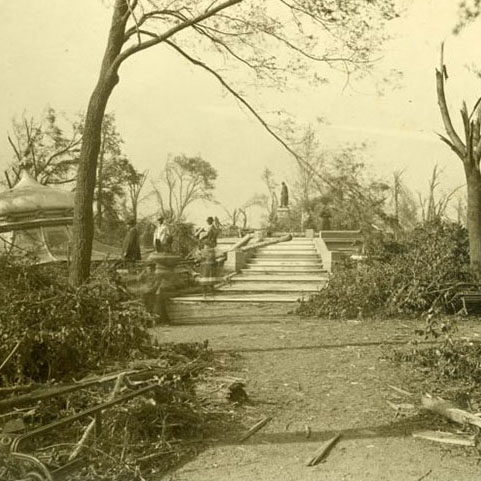
It then stormed east into Lafayette Park and the elegant homes that surrounded it. The 36 acre park was turned into “a wasteland of stripped trees and stumps.” in a matter of seconds. Gazebos and pavilions were hurled into the sky. Pieces of the main bandstand were found over four hundred yards away. Many of the stately homes and churches that surrounded the park were laid to waste.

Lafayette Park

Lafayette Park was a place of beauty and joy to the residents of south city. The first public park in the city of St. Louis, its destruction delivered to them a severe blow.  Surveying the damage from the balcony of his home, a Lafayette Square resident named Charles Simpson openly wept. Although his family was safe, he lamented the destruction of the park he loved dearly. He turned to his son-in-law and said “It took forty years to grow those trees, and I shall never see their like again. The house I can repair, but my trees are gone forever”.

Lafayette Square

The tornado continued east, now bearing down on the massive City Hospital complex. Containing over 400 patients, the tornado ripped roofs and floors away. The crematorium was instantly demolished. One newspaper reported that a patient named George Wilson was sucked out of his second floor room. Amazingly, he landed upright and was able to run back into the basement of the building. Another patient was pulled from his fourth floor room and thrown over 150 yards away. Miraculously, that patient also suffered only minor injuries.

The City Hospital after the tornado

Moving past the hospital, the tornado was still gaining power. It reached its full fury in the Soulard neighborhood, near an intersection that would come to be known as the “vortex”.  Here, at the corner of Seventh and Rutger Streets, a man named Frederick Mauchenheimer owned a tavern on the ground floor of a tenement building. As he sat at a table playing cards with two patrons, the tornado slammed into the building. Every floor of the building collapsed down. Mauchenheimer survived, but the other card players and fifteen others died. Six more people died across the street. The day after the storm, the body of seven-year old Ida Howell was found in the arms of her mother.

The scene at the corner of Seventh & Rutger streets

After wreaking havoc in the Soulard neighborhood, the storm turned north and continued its carnage on the riverfront. Over twenty steamboats, tug boats, and ferries were ripped from their moorings and destroyed. The steamboat “Anchor Line” was hurled across the Mississippi, crashing into pieces on the eastern shore of the river. Although the official death toll on this day is 255, many believe the number is much higher. On the riverfront, scores of people lived in shanty boats. Since their bodies were washed downriver, perhaps as many as 150 deaths were unaccounted for.

Wreckage of the steamboat City of Vicksburg

As the tornado moved across the river, even Eads Bridge wasn’t spared. The top abutment of the first pier, including the girders and rocks, was picked up and thrown onto the tracks behind a passenger train. Two baggage cars were knocked off the tracks. Wagons loaded with goods and merchandise were thrown on top of them.

Eads Bridge on the East St. Louis riverbank

As the tornado moved onto the Illinois side of the river, residents of East St. Louis ran for cover as they watched entire homes pulled from the ground. More than 100 people on this side of the river were killed in a matter of minutes.  The police station and courthouse were completely destroyed. Inside that courthouse, a jury deliberating a case barely escaped with their lives. It wasn’t until minutes before the tornado hit that the judge allowed the members of the jury to flee and find safety.

The tornado was especially deadly at the various rail yards and depots in East St. Louis. When the storm hit the St. Louis, Vandalia, and Terre Haute Railroad Depot, fifteen of the thirty-five workers were killed.

The East St. Louis railyards

When the tornado finally dissipated, St. Louis and East St. Louis were wrecked cities. People emerged by the thousands to survey the damage and search for loved ones. Rescue efforts were organized to locate survivors buried under brick and rubble. One woman was found alive after being buried for over two days. Throughout both cities, the death toll clicked higher as victims succumbed to injuries. Many newspapers reported people physically unharmed by the storm still died of “shock”, and “fright”.

The day after the tornado, hundreds of people began gathering at city morgues to identify lost loved ones. Bodies were laid out on pine boxes as wagons departed and returned with more victims of the storm. At the St. Louis Morgue on 12th and Spruce, the crowd became so large that the police were called in to restore order.

Hundreds gather at the St. Louis Morgue

People come together in the wake of tragedy, and St. Louis in 1896 was no exception. Laborers were hired to remove debris. People who lost their homes were fed and given shelter. Communication was first restored to Kansas City, and then Chicago. Quickly, the rest of the country would come to learn about the tragedy that befell St. Louis. In the coming weeks and months, St. Louis slowly started to rebuild the homes, churches, and factories that it had lost.

Today, Lafayette Square is again one of the most beautiful neighborhoods in the city. Tower Grove Park, Compton Heights, and Shaw’s Garden look as elegant as ever. Hundreds of trees now stand tall in Lafayette Park. The City Hospital still stands as an attractive condominium complex. Although few signs of that storm are visible in St. Louis today, it’s a remarkable and tragic event in the history of the city.

The Drink

Square One Brewery

Well, this is a very depressing post to try to tie a drink to, but I’m still gonna do it. And, since that tornado cut quite a swath through St. Louis, it’s not difficult to find a bar that has ties to it. For this one, I chose Square One Brewery & Distillery in Lafayette Square. I know this place well since it’s on my bike route and the building’s previous tenant was my company’s after-work hangout years ago.   Today, Square One lays claim to being the first microdistillery restaurant in the state of Missouri. They pride themselves on pairing food, beer, and spirits together. Personally, I think they do a great job because I’ve always left happy. They brew an excellent selection of craft beers in small batches that are very good. They also make a good whiskey that I’ve had on a few previous visits.

I was tempted to see what Square One would do with a Manhattan. Instead, I checked out their cocktail menu and found a drink that seemed more appropriate for the subject of this post.

The “South Sider” contains Square One’s JJ Neukomm Whiskey, a dash of bitters, and Fevertree Ginger Beer. It’s served on the rocks in a tall glass. I haven’t experimented much with mixing beer and spirits, but this was a good start. The bitters added a nice spicy flavor and I enjoyed the drink.

I asked the bartender if he knew anything about the history of the building. I was told it was built before the tornado, but he did not know the extent of damage it took. Maybe I’ll find out more on my next visit.

The South Sider at Square One

divider
The Great Cyclone

Almost all of the information for this post came from the book The Great Cyclone at St. Louis and East St. Louis, May 27, 1896. It’s a compilation of stories that appeared in St. Louis daily newspapers after the tornado hit. It was first published just days after the tornado hit in 1896. It was recently republished and a new forward was added by St. Louis Post-Dispatch writer Tim O’Neil.

All photographs used in this post are courtesy of the Missouri History Museum.

September 10th, 2012 by Cameron

The St. Louis Motordrome

St. Louis Motordrome Racer Wells Bennett - Photograph by J.R. Eike, courtesy of Thomas Kempland

One of the joys of starting this blog is how I sometimes just bump into the hidden past of St. Louis. These days, when I bike to work, drive around, or explore new parts of the city, I’m always on the lookout for something new. This city is filled with history. As a result, I have started filling up notebooks and blog drafts with ideas and topics that I plan to investigate at a later date.

Recently, I found records of a St. Louis structure that I had never heard of before. I was clicking through some St. Louis websites looking for ideas, and I stumbled upon a webpage filled with a fascinating collection of old photographs.

The collection contains about 100 photographs taken by a man named J.R. Eike between the years 1914 and 1917. They come from a collection of glass plate negatives recently rescued from the trash heap by a St. Louisan named Thomas Kempland. Knowing he had quite a find on his hands, Mr. Kempland took the time to digitally scan the plates and post the images on the Internet for others to enjoy.

Even better, I was able to track Mr. Kempland down and get his permission to use them for this post. The images in this post are copyrighted and are not public domain. I am grateful to Mr. Kempland for allowing me to share them on this blog.

The photographs provide a fantastic look at St. Louis nearly 100 years ago. Included are images of Forest Park, random street scenes, parades, and various church groups. It also contains noteworthy images such as the aftermath of a tornado, construction of an Anheuser-Busch Brewery, and the opening of Bevo Mill. Back in his day, Mr. Eike was obviously a prolific photographer.

The images that really drew my attention were a series of photographs of men posing on old-time motorcycles. As I looked them over, I also noticed the peculiar track they were posed on. One particular photograph, taken on September 6, 1914, shows the track from above. The word “Motordrome” is written across the image. I had never heard of a “motordrome” before, but the steep banking curve in the photograph looked completely insane. People raced motorcycles on tracks like this? And one existed in St. Louis? I had to find out more about this structure.

The St. Louis Motordrome

After a bit of research, I was able to find more information about motordromes. It turns out they were arena-like structures built for a popular sport during the the 1910′s and 1920′s called “Board Track Racing”.

Board track racing evolved from the European velodrome, on which bicycles would race on circular or oval tracks with banked curves. Eventually, unique structures for motorcycle racing were built with higher banks that enabled faster speeds. They were made entirely of wood, which made them cheap to construct. Even the track surface was made of 2×4 wooden planks, hence the name “board track racing”. In time, the wooden structures came to be known as “motordromes”.

And St. Louis had one of the most remarkable motordromes of them all. It was located in Priester’s Park, an amusement resort that was located at the intersection of Grand and Meramec in south city. Priester’s Park is also noteworthy in that it was the first park in St. Louis to host hot air balloon racing competitions. That tradition continues to this day in St. Louis, notably with the Forest Park balloon races that are held each year. In this early plat drawing, the St. Louis Motordrome can be seen as a circular 1/4 mile track. It was twenty-four feet high and could hold fifty thousand spectators

St. Louis Motordrome Map

(plat image courtesy of carlylehold)
 

Today, no trace of Priester’s Park or the St. Louis Motordrome remains. Over the years, several houses and businesses have been built on the triangle-shaped corner of Grand and Meramec. From the parking lot of a restaurant that sits on the corner, the image below looks toward the general area where the motordrome once stood.

Priester's Park Today

The first motordrome in the United States was built in 1909 in Los Angeles. The banking curve of that track had an angle of about twenty degrees. As the sport grew in popularity, tracks started being designed with steeper banks in order to increase speeds and give racers an easier time handling a motorcycle. The person (or should I say “maniac”) who designed the St. Louis track gave it a banked curve with a whopping sixty-two degree angle. It was the steepest motordrome banking curve in the world. On such an angle, racers could “ride the boards” at speeds over one-hundred miles an hour. To make it even more interesting, the motorcycles didn’t have a suspension, clutch, throttle, or brakes. It was simply full-go. To slow down or stop, racers had two choices: 1. Use a kill switch to stop the engine and coast, or 2. Crash.

It was an extremely dangerous sport for competitors and spectators. Faster speeds brought higher casualties. Deadly crashes became common since racers wore minimal safety equipment. Even if a crash was avoided, racers had to worry about being impaled by splinters or hitting loose nails. Fans watched board track racing from above and looked down on the action. If a rider lost control, it usually resulted in a motorcycle and rider flying off the track and into the crowd. Unfortunately, St. Louis was not immune to such tragedy. Here are two clippings from St. Louis newspapers at the time depicting horrible crashes.

St. Louis Motordrome Crashes

(images courtesy of carlylehold)

The most notable board track racing tragedy occurred in Atlantic City, New Jersey, in 1912. Eddie Hasha, dubbed the “Texas Tornado”, was racing at about ninety-two miles an hour when he lost control of his machine. As a result, he rode directly into the upper rail surrounding the track. His machine struck a post, throwing Hasha into the grandstands and killing him instantly. At least five spectators were also killed, most being teenagers who had leaned their heads over the rail to watch the crash. While Hasha flew out of the track, his motorcycle kept going. It dropped back down onto the racing surface and collided with another racer. That racer was knocked unconscious and died four hours later in a hospital. Several people suffered broken bones and wounds from the panic of the crowd as it attempted to get out of the way. It was such a tragic event that it made the front page of the New York Times. Many point to that crash as the beginning of the end of board track racing in the United States. The shorter 1/4 and 1/2-mile circular tracks (such as the one in St. Louis), were quickly nicknamed “murderdromes” by the media. Soon after, the national organization that oversaw motorcycle racing banned tracks shorter than one mile.

Another reason board track racing fell out of favor was the high cost of maintenance. Since motordromes were made of wood, the tracks needed constant upkeep. Adequate weather proofing was not available at the time, so continuously putting in new wooden tracks became expensive. By the early 1930′s, board track racing in the United States all but disappeared. Although board track racing is no longer a competitive sport in the United States, it still maintains a fanbase in Europe, particuarly Germany.

The St. Louis Motordome is long gone, but thanks to the efforts of people like Mr. Kempland, we have some great photographic records of the track and the racers that competed on it:

Board Track Racer Wells Bennett

Unknown Bicyclist at St. Louis Motordrome

Unknown racer at St. Louis Motordrome

Group photo at St. Louis Motordrome

St. Louis Motordrome Racer Paul Schmidt

Board track racer John B. Hoefeler

Board track racers at St. Louis Motordrome

Unknown Racer outside St. Louis Motordrome

Unknown Racer at St. Louis Motordrome

The Drink


The Feasting Fox

Finding a drink for this post was a piece of cake. At the corner of what was Priester’s Park now sits one of the most noteworthy eating and drinking establishments in St. Louis. Built in 1913, Al Smith’s Feasting Fox is one of two establishments in St. Louis city that were originally built and operated by the Anheuser-Busch brewery (the other being Bevo Mill).

The Feasting Fox was originally known as “Busch’s Gretchen Inn”. It’s a distinct building with a timber and stucco construction. It has a steeply pitched roof and a unique corner turret. It looks like it was plucked out of Bavaria and dropped in south St. Louis. The style reflects the early German population of St. Louis and the Dutchtown neighborhood it sits in.

Bush’s Gretchen Inn and Bevo Mill were built in an effort by Anhueser-Busch to show that beer could be served in respectable family establishments. At the time, alcohol was generally served in seedy saloons filled with ruffians and drunkards. It was places like these that gave the prohibition movement momentum.

In 1920, the 18th ammendment was enacted, prohibiting the sale, manufacturing, and transportation of alcohol. Anhueser-Busch was able to stay in business by selling a range of non-alcoholic products. As a result, its two restaurants in St. Louis city also remained open. However, when prohibition was repealed in 1933, new anti-trust laws forbade breweries from operating drinking establishments. The restaurant was leased to a man named Al Smith, who changed the name of the restaurant to “Al Smith’s Feasting Fox”.

Tasty Dopplebock

The Feasting Fox evolved over the years. It had some ownership turnover and even sat empty for several years in the 1980′s. It was purchased and rehabbed to its current condition in 1993. It’s a striking when one drives towards in on Grand Avenue. And despite my years of poking through the corners of St. Louis, I had never been inside. Since it once sat in the shadow of the St. Louis Motordrome, it was time to get a drink at the Feasting Fox.

I visited the Feasting Fox in the late afternoon on a Saturday. It had just opened, so the few customers inside made it seem like a relatively quiet tavern. The inside decor is eclectic, historic, and inviting. The bartender (a very friendly fellow) identified me right away as a Feasting Fox rookie. After learning that I was doing a little research, he recommended a Weihenstephaner dopplebock. Due to the Anhueser-Busch origins, getting a beer at the Feasting Fox seemed far more appropriate than a cocktail. Along with a variety plate of tasty German sausages, I kicked back and enjoyed a few beers.

I look forward to heading back to the Feasting Fox with some pals. It’s historical and it’s cool to think that you are drinking in the same building where motordrome racers and spectators would throw a few back after a day of racing (and if there was a crash, they probably needed more than a few). It doesn’t seem to be a place to go for cocktails, but it’s a definitely a unique place to bring out of town guests for a few beers and some German food.

The Feasting Fox


July 16th, 2012 by Cameron

The Campbell House & Virginia’s Punch

Campbell House Museum

It’s not difficult to find historic houses in America. Travel around this country and it seems every town claims to have at least one or two homes that have stood the test of time.  Few, however, can match the history, authentic restoration, and original content that can be found in the house that sits at 1508 Locust Street in St. Louis.  This is where the Campbell House sits, and it’s a remarkable place. For eighty-four years, from 1854 to 1938, a wealthy fur trader named Robert Campbell and his family called this home. Today, it’s a museum and one of the most accurately restored 19th century homes in the United States.

The home was originally part of Lucas Place, an exclusive neighborhood that was located on the western edge of the city. Developed in 1849, Lucas Place was the first suburb and the first clearly defined wealthy neighborhood of St. Louis. I plan to write more about Lucas Place future posts, but for now I’ll simply say that it didn’t last long. As St. Louis rapidly grew in the 19th century, wealthy St. Louisans continued moving further west to neighborhoods such as the Central West End and Vandeventer Place. As a result, the stature of Lucas Place declined as early as the 1870′s. By 1900, only a few of the original Lucas Place mansions remained. Despite the transformation of the neighborhood around them, the Campbell family stayed put.

Lucas Place
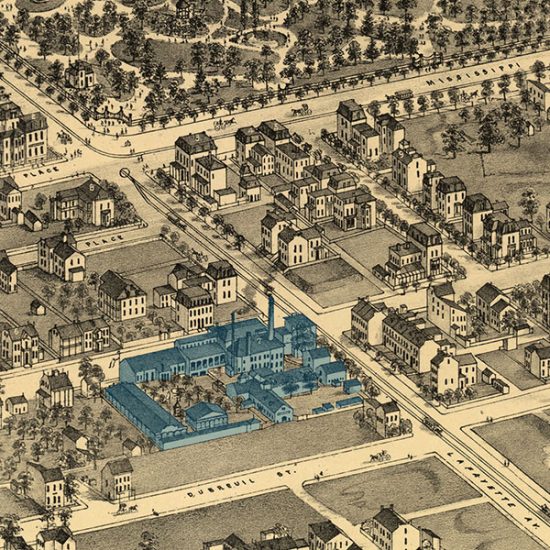
This is Plate 42 of Compton & Dry’s Pictorial St. Louis 1875.  This map shows the dramatic neighborhood change compared to today.  Campbell House is circled below, surrounded by several much larger houses.  Today, all of the structures that surround it are long gone.
Compton & Dry - Plate 42

The other white dots mark three churches. Along with the Campbell House, these structures are the only buildings depicted in the drawing that still exist today.

Robert & Virginia Campbell

When I first toured the house last year, I was fascinated by the stories I heard about the house and the family that lived there.  Robert Campbell was born in Ireland in 1804 and came to America in 1822. He eventually came to St. Louis and became a fur trader. He spent the next ten years of his life in the Rocky Mountains, learning the trade and ultimately creating his own company. Upon returning to St. Louis in 1835, he embarked on many profitable business ventures that caused his wealth to grow significantly. By the early 1850′s, Robert Campbell would be one of the richest men in Missouri.

Also in 1835, Robert met his future wife, Virginia Kyle. At the time, he was thirty-one and she was only thirteen.  Despite the disparity in age, the two became close and began writing letters. After a lengthy (and turbulent) courtship, Robert and Virginia married 1841. In 1854, they bought the home on Lucas Place that is now called Campbell House.

Parlor, Servants Bells, & Sunglasses

Together, Robert and Virginia Campbell had thirteen children. Tragically, only three of them would survive past the age of seven.  Three sons (Hugh, Hazlett, and James) would continue living in the home long after their parents passed away. However, none of them would marry or have children of their own. When the last surviving son died in 1938, eighty-four years of Campbell tenure in the house came to an end.

Me at the Campbell House

This is all just scratching the surface. I’m writing this post because if you are reading it, you need to get over to this house and see it. Even better, you could land me as a docent. I started volunteering at Campbell House in January of 2012. I love the place. It’s filled with history-minded people (and a few drinkers) that I naturally get along with. I learn something new each time I walk through the door. Eventually, I even hope to begin assisting with some research projects.  There’s still much to learn about the Campbell family and the home they lived in. Until then, I’ll continue giving killer tours (and possibly mow the lawn from time to time).

If you come for a tour, you’ll learn the story about the house, the family, and the servants that worked for them. You’ll hear about Virginia’s parties, hosting elaborate dinners for prominent St. Louisans such as James Eads, Henry Shaw, Susan Blow, and William Tecumseh Sherman. During his Presidency, Ulysses S. Grant is known to have dined at the Campbell House on at least three occasions. You’ll also get insight into why the Campbell House stills stands. As the neighborhood transformed around them, there’s evidence to show why the Campbell family never left.

You’ll also see original Campbell furniture, artifacts, paintings, and photographs. The decor, paint, carpet, and fixtures have been painstakingly restored to what the house looked like in 1885.  It’s a great window into the past. For more information, visit the Campbell House website. They also write a great blog, covering all sorts of fun Campbell and St. Louis history topics.

The Manhattan

As I mentioned, one of my favorite aspects of working at Campbell House is that each time I walk in the place, I learn something new. There are so many people who work there that are passionate about one subject or another. My new pal Shelley, the Assistant Director of Campbell House, is a big foodie. She introduced me to Virginia Campbell’s handwritten cookbook. Inside is a recipe for a punch recipe that I’ve been told is very good.

Virginia's Roman Punch Recipe

Here’s the recipe card, which you can get your own copy of when you come to Campbell House.

Roman Punch

Grate the rinds of 12 lemons, & 2 oranges on 2 lbs of beet sugar, and squeeze on the juice, over it, and stand until the next day, then strain it through a sieve, add a bottle of champagne & the whites of eggs beaten to a froth. Freeze or not

Of course, I had to try making Virginia’s recipe for this post. Even better, I wanted to learn more about the history of punch. I knew that punch goes way back in the history of drinking, much farther back than cocktails. That’s about all I knew.

Today, punch is often known as some sort of Kool-Aid concoction made with floating fruit. It’s often non-alcoholic (except at proms). In college, we used to make a variation of punch called “Hairy Buffalo”. Our recipe started with soaking apples and oranges in grain alcohol.  When properly saturated, we’d dump the fruit into a garbage can and fill it with Kool-Aid and more grain alcohol.  Older and wiser, this is not the kind of punch I want to research or drink (ever again).

Drinking Punch

Punch actually has quite a history to it. The term “punch” actually comes from the Hindi word “panch”, which means “five”. It’s named as such because that is the specific number of ingredients used to make the drink.  The original ingredients vary by source, but it’s always five and one of them is always alcohol. The others could be sugar, a bitter aperitif, lemon juice, beer, milk, tea, spices, or wine, considering which source you refer to.

The term “punch” first shows up in British documents in 1632. It’s believed that it was introduced the west by British sailors and employees of the East India Company.  Since that time, the variety of punch recipes has become extensive.

Anyway, back to Virginia’s recipe, which is named “Roman Punch”.

Virginia's Roman Punch

Making the punch was a pretty comical adventure. I grated my thumb a few times along with the lemons, I had no idea where I could get “beet sugar”, and the process of frothing an egg white was completely foreign to me. Fortunately, I had help from my friend Gina who’s a great cook. I’m also very happy I didn’t put Gina’s eye out when I popped the champagne cork (it bounced off two walls before we even heard it).

I chose to freeze the drink for several hours to make it nice and cold. I had five friends come over and help me drink it. I’m happy to say it came out far better than I expected. It’s extremely sweet and extremely uh, “lemon-y” (12 lemons will do that). I wouldn’t drink it all day, but I think it would make a nice drink on a hot summer afternoon. My pals each said they liked it. They each had a glass before tackling the stash of beer in my refrigerator. I’ll have to try some other historic punch recipes in the future.

July 12th, 2012 by Cameron

The Jacob Stein House

Head south on Broadway from downtown St. Louis and you’ll soon find yourself in a unique part of town. You’ll be in Carondelet, a large neighborhood that seems to maintain its own identity.  The vibe is different there because Carondelet used to be a separate city entirely.  Incorporated in 1851, Carondelet did not become part of St. Louis until it was annexed in 1870.

Carondelet was first settled by a man named Clement DeLore Detreget in 1767. He was a Frenchman, but the future of Carondelet would be all German. In 1829, a German emigration writer named Gottfried Duden published a famous book titled Bericht über eine Reise nach den westlichen Staaten Nordamerika’s (Report of a journey to the western states of North America). In this book, Duden refers to the area around St. Louis as a “Rhineland of the West”.  His glowing report triggered a huge German immigration to Missouri starting in the 1830′s. By 1850, Census records show that over one-third of Carondelet was German.

The Jacob Steins House

Today, Carondelet is known for containing one of the largest (and most beautiful) public parks in St. Louis. It’s also teeming with historical structures. In the 19th century, German stonemasons built sturdy homes throughout the area that could stand the test of time. Today, Carondelet contains the largest number of stone-built homes in St. Louis.  Some of them are among the oldest structures still standing the St. Louis.

One of them is located at 7600 Reilly Avenue. It’s known today as the Jacob Stein House. Jacob Stein was an important citizen of Carondelet prior to the Civil War. He was an immigration agent, so he also played a role in promoting the area to German immigrants. The neighborhood around his home even became known as “Steins Town”.

Built in 1843, the house is a perfect example of the limestone construction used by German stonemasons at the time. Here’s a photograph of the Jacob Stein house in the late 1800′s.

The Jacob Stein House

In the years after construction, one end of the home was converted into a tavern and a store.  With the neighborhood filled with thirsty Germans working nearby iron and steel mills, it’s a safe bet that making beer readily available would be a profitable venture.  The tavern has since been removed, but the original bar still exists inside the current home.

I learned about this house and the German heritage of Carondelet while on a bicycle tour organized by Trailnet and sponsored by Great Rivers Greenway. On this tour, about twenty-five riders were treated to a historic tour of Carondelet by a brilliant guy named Harold Karabell. I’ve mentioned him before in my post about the Big Mound of St. Louis. He gives a great tour and he has an encyclopedic mind.

Harold & the Bike Tour

A highlight of the day occurred when the current owner of the home came outside to determine why a bunch of people in spandex were gawking at his home. He was a very friendly gentleman who was well aware of the significance of his home. He even produced a photograph he owns of Jacob Stein, the original owner.

Jacob Stein House & Current Owner

The Jacob Stein House was named a St. Louis city landmark in 1976. I’ll have other posts from this bicycle tour of Carondelet coming soon.

Note: I can’t recommend Trailnet highly enough. They have a calendar filled with bicycle rides and similar tours of St. Louis. Not only do they do great work for bicyclists, they do great work for the city of St. Louis. It’s only $55 to become a member, and it’s worth every penny.

The Drink

The drink section of this post took me to a location that I have been meaning to visit for quite some time.  One of the great things about living in St. Louis for the last few years has been taking part in the craft beer explosion that’s happened in this town. New micro-breweries such as Square One, Civil Life, Urban Chestnut, and 4 Hands have popped up all over the city. Carondelet has the distinction of having one of the best new additions to the St. Louis beer scene: Perennial Artisan Ales.

Blueberry Brown Rye

Many craft beer aficionados had been telling me to check this place out for some time.  I just hadn’t made it down there since Carondelet is not in my neck of the woods. Since the Trailnet bike tour took me right past their location, I thought it’d be a perfect time to head over and see what they had to offer.

Perennial focuses on small batches of beer using ingredients and flavors that defy traditional categories. The building offers a spacious bar area and I found the service to be extremely friendly (in other words, they gave me a big free sample of cider). To begin, I ordered their Blueberry Brown Rye.  I did this on purpose, since I normally don’t care for fruit flavor in anything. I love fruit, I love food, and I love beer. But I prefer to keep it all separate. Just like I don’t like blueberries in a bagel, I usually don’t like blueberries in a beer. However, Perennial’s recipe swayed me on this day. The fruit taste was subtle and I found it extremely tasty. I ended up having two.

I followed that up with their Hommel, a dry-hopped Belgian pale ale. Again, very delicious. In all, I highly recommend Perennial, especially to beer lovers looking for something a bit different.

I look forward to getting back to Perennial and I hope they continue to make an impact on the St. Louis beer scene.

July 2nd, 2012 by Cameron

Compton & Dry’s View of St. Louis

Back in the early 1870′s, a man named Richard J. Compton came up with a pretty big idea.  Compton wanted to design and publish a new perspective map of St. Louis on a scale that had not been attempted before. The result would become the most important and significant map of any American city to date. Even by today’s standards, this map stands out as a significant achievement in cartography.

Perspective maps (also called panoramic, pictorial, or birds-eye maps) had been popular since the 16th century. But in the 1800′s, the industry really took off. Thousands of maps were drawn to present attractive views of cities in order to lure potential industry and people to a city. Being one of the largest American cities in the late 1800′s, St. Louis was no exception.

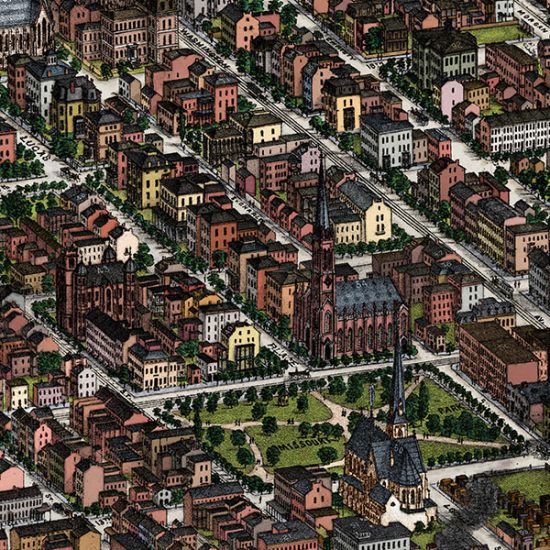
One example is the Parsons & Atwater map, published by Currier & Ives in 1874:

1874 St Louis - Parsons and Atwater

It’s a beautiful map, but it is not an exact replica of the city.

1874 St Louis - Parsons and Atwater Detail

Look closely at the detail and the viewer will notice that buildings in certain sections of the map become haphazardly drawn and repetitious. The perspective is not correct, especially as the city spreads out to the west.

This is exactly what Compton sought to avoid. A printer by trade, his goal was to publish a fully detailed perspective drawing of St. Louis. In it, every building, street, park, landmark, business, church, and structure would be drawn in detailed precision.

Compton was from Alton, Illinois. He served as the manager of a lithography company in St. Louis and he owned his own business under the name of Richard J. Compton & Co. It was this firm that would publish his new map. To draw the map, he hired an artist by the name of Camille N. Dry. Not much is known about Dry, but he had a background of drawing perspective maps for several other cities. It’s almost certain that Dry managed a team of artists to help with the massive project.

To make his drawing, Dry made initial sketches from a hot air balloon that was floated over the Illinois side of the Mississippi River.  Dry also used this birds-eye view to determine the correct perspective needed for a map of this size. Since a map of such detail would require an enormous surface area, the plan all along was to publish the map in book form.  When complete, it consisted of 110 individual drawings or “plates”, each depicting a section of St. Louis.  Along with the plates, 112 pages of descriptions are included in the final publication. These descriptions give details about the thousands of businesses, buildings, and structures drawn in the map. At the time of its publication, no other American city could claim a map with such meticulous detail of its urban landscape.

It was published with the title Pictorial St. Louis: The Great Metropolis of the Mississippi Valley, a Topographical Survey Drawn in Perspective A.D. 1875. 

Pictorial St. Louis 1875 Cover Page

The title page credits Camille Dry as the artist and Rich. J. Compton as the designer and editor. It’s believed the initial sketches took place in the spring of 1874. The final book was published in December 1875. It sold for $25.00.

I first saw this map in its full glory at the Missouri History Museum when I first moved to St. Louis. They had the entire map up on a wall as part of a St. Louis exhibit. It’s since been taken down to make room for newer exhibits, but one can hope it will be put on display again in the future.

Since this map is so big, it’s difficult to fully appreciate on a single webpage. The approximate size of each plate is 11×18 inches. If you were to assemble all the plates together to make one big map, you’d need a wall at least 24 feet long and 8 feet high.  Even Compton and Dry did not intend to have the map viewed in such a manner.  Since the map was published in book form, many buildings and map features are duplicated on adjoining plates.

Scale the plates down, and it could fit on your living room wall, which is where I put it (read more about that in this post).

Compton & Dry on my wall

However, just by looking at a few of the individual plates, it’s easy to appreciate what Compton & Dry accomplished. This is plate 43, which shows the area around Washington Avenue and 14th Street.

Plate 43

Compton funded the work by selling subscriptions. By detailing every structure in the city, he could identify buildings and businesses by numbers etched on a plate. A paying subscriber could then get a business identified on the map and in the key below the image. A description of the business would also be included.  It’s assumed Compton charged more for longer descriptions that took up more space. For example, the description of the “Belcher Sugar Refining Company” fills an entire page, something that must have called for a higher subscription price.

Find a copy of the book and it’s easy to get lost in it. I have spent hours examining the plates looking for landmarks and buildings that still stand. Here are six that can still be seen in St. Louis today:

Pictorial St. Louis 1875 Buildings

Pictorial St. Louis 1875 Buildings

It’s also interesting to see what’s not yet there. Plate 1 shows a congested city and riverfront where the Gateway Arch now stands.

Plate 1

Plate 94 depicts a spacious Tower Grove Park in 1875. Henry Shaw’s land sits barren to the north where the Missouri Botanical Garden would eventually be built.

Plate 94 - Tower Grove Park

Plate 84 shows a small baseball diamond on the west side of Grand Avenue. This small ballpark would eventually evolve into Sportsman’s Park, the future home of the St. Louis Browns and the St. Louis Cardinals.

Plate 84

I strongly recommend seeing this book in person. It’s a stunning achievement in cartography and art. It’s also easy to find. It can be viewed on-line at the Library of Congress here. The St. Louis Public Library has copies at several of their branches. Recent republications are usually available for purchase on eBay.  But if you happen to stumble upon one of the original copies printed in 1875, you’ll likely need to fork over about $10,000 to call it yours.

The Drink

I thought heading out to get a drink for this post would be easy. Since my history topic literally deals with the ENTIRE city of St. Louis, I simply had to choose a bar and a drink. However, I figured I should try to find a place that can be found and identified on the Compton & Dry map.
Broadway Oyster Bar

But I couldn’t find one. It’s sad to realize how many 1875 St. Louis buildings are gone. It seemed each old bar I looked up was located in a building that been built after 1890. Fortunately, all I had to do was call my pals over at the Campbell House Museum. The director, Andy Hahn, needed about four seconds to tell me of a place I should have known all along:  Broadway Oyster Bar. It’s in one of the oldest buildings still standing in St. Louis.

Broadway Oyster Bar is a fun place. They have great food (it’s where to go in St. Louis if you like to eat crawdads), music, and a very eclectic interior. It’s not a place I’d go for a cocktail, but it’s a great place to drink beer and listen to blues. It gets loud, which is tough for guys who are deaf in one ear (me). But, it’s still a place I often take friends who are visiting St. Louis.

Broadway Oyster Bar in 1875

The building that houses Broadway Oyster Bar was constructed in 1845. The original hearth even still stands in the back dining room.  On plate 3 of the Compton & Dry map, a group of houses are drawn at the corner of 5th and Mulberry, which is now the corner of S. Broadway and Gratiot.  They aren’t identified, but I believe one of those structures is where I ordered a Manhattan on a recent hot Saturday afternoon.

Since it was 102 degrees, I sat at their nice outdoor bar where it was empty (the inside was packed with people escaping the St. Louis heat). My bartender thought I was nuts biking in this weather, but she was very friendly and happy to make me a Manhattan. I ordered it without any special instructions, which means I expected to get it on the rocks (sigh).  She used a good 2:1 ratio of Maker’s Mark Whiskey with Martini & Rossi Sweet Vermouth. She put three maraschino cherries in it and a a splash of maraschino juice. It was stirred, and no bitters were added.

Broadway Oyster Bar Manhattan

I’d send this drink back at some other establishments, but not here. I know better than to be a cocktail snob to a pretty girl who’s being extra friendly. She could have topped off the Manhattan with Mad Dog and I would have simply smiled back. It was still a tasty drink. She poured a good ratio and the ice probably helped on a super hot day.

Normally, that’s way too many cherries for a Manhattan. I don’t use even one in my own recipe. Still, the maraschino cherry is the standard fruit complement to a Manhattan. I certainly will not complain when it’s added.

Notes:

Much of my information about Compton & Dry came from a fantastic book titled St. Louis Illustrated Nineteenth-Century Engravings and Lithographs of a Mississippi River Metropolis by John W. Reps. The book is now out of print, but I was able to purchase a copy in great condition for only $6.00 from an online used bookseller.

June 25th, 2012 by Cameron

The Big Mound of St. Louis

Big Mound Rock

Head north of downtown St. Louis and you may bump into a peculiar monument. A big rock, raised up on four levels of brickwork, sits near the intersection of Broadway and Mound Street in the Old North St. Louis neighborhood. Inconspicuous, this rock actually marks a significant site in St. Louis area history. This is where “The Big Mound” once stood, the largest of the Indian platform mounds that dotted the landscape where the city of St. Louis now stands. An extension of the famous Cahokia Mounds on the eastern side of the Mississippi River, these mounds were built by the Mississippian culture that thrived in this area between 900 A.D. and 1300 A.D.

I first heard about this landmark on a recent guided bike tour of the Mound City Interpretive Trail, sponsored by Trailnet. A local historian named Harold was our guide, and his knowledge of St. Louis is extraordinary. As we rode, we’d stop often and he’d throw out great history facts and stories about the Indian mounds and nearby communities. At one stop, he briefly mentioned a mound that once existed on the St. Louis side of the river. He said a monument even still stood for it. I knew right away it would be a great topic for this blog. When the tour was over, I headed over the river and found the rock. I can’t believe I hadn’t noticed it before. I often bike up and down Broadway on history hunting rides. It simply never caught my eye. But back in 1850, you couldn’t miss what stood there.

Big Mound

The mound stood approximately 30 feet high, extended about 150 feet, and had an oval shape. It had a flattened top that was about 15-18 feet wide. When St. Louis was initially settled by the French, it was called “La Grange de Terre”, which means “Earthen Barn”. It was later referred to simply as “The Big Mound” since it was the biggest of the twenty-seven Indian mounds that dotted the western side of the river. The image below shows an early survey map of the St. Louis mound group. Big Mound is circled in red.

St. Louis Mound Group

In the 1840′s and 1850′s, St. Louis began to grow rapidly. It was decided to level “The Big Mound”, and it finally came down in 1869. The dirt and clay from the mound was used as back fill and to make brick for a growing city. Sadly, very little (if any) archaeological work was done during its demolition. However, some early St. Louis knew enough to take some daguerreotypes of the mound before it disappeared for good.

Destruction of Big Mound in 1869
A granite boulder is all that remains today. It’s in an industrial part of St. Louis that doesn’t get much traffic. A plaque was once attached to the rock describing the significance of the site. It seems to have been stolen, but my guide Harold says it was intentionally removed to prevent it from being stolen. On the other side of the boulder, an attractive plaque of a Native American remains in place.
Big Mound Plaques
Get down to see the rock while you can. The boulder is schedule to be relocated to make room for a new 700 million dollar Mississippi River Bridge, scheduled to open in 2014. Look east from the rock today and you’ll see the giant spires of the new bridge directly in front of you. The new bridge will pass directly over the former location of Big Mound. While you are at it, head south of downtown and check out Sugarloaf Mound. It’s the only Indian mound in St. Louis that still stands.
The Drink
Rye Manhattan at the Royale

As discussed in the About This Blog page, my idea for this blog is twofold. I want to find historical places in St. Louis that pique my curiosity. While I do it, I want to find places in St. Louis where I can get a good cocktail. Since this is my first blog post, I wanted to get a drink where I know I’d get a good one.

Most of the time, that place is the Royale on South Kingshighway. It’s a pleasant bar with good food and a fun decor. It’s a good place for liberals like me to hang out and read a book (the lighting is great during the day). The Royale prides itself on knowing and serving classic cocktails. Their drink menu is filled with old-time drinks such as the Old Fashioned and the Sidecar.  Each recipe has a bit of a unique Royale twist that I always appreciate. Not really wanting a unique twist with my Manhattan on this day, I still felt pretty confident that I could sit down order “a Manhattan cocktail” and get one perfectly done without any special instructions.

And dammit, it didn’t happen. They gave it to me on the rocks. I believe a Manhattan should always be straight-up. The Manhattan rocks drinkers are ruining it for the rest of us. You should all be banished to a remote island. Still, my bartender had it pretty close (except for serving it in the wrong glass and filled with ice). He used about a 50/50 split of Rittenhouse Rye 100 along with Dolin Sweet Vermouth. It had a couple of dashes of Angostura bitters and a small lemon peel (which is a unique twist I do enjoy). It was stirred, which is also correct (Manhattan shakers also get banished to Bad Cocktail Island).

Spare a lemon peel?

I had ordered it straight-up, so I had no problem sending it back. My bartender then just strained it into a martini glass (sigh).  But instead of a new lemon peel, he fished into the ice with his fingers and re-used the old peel. It was pretty disappointing for a place that even hosts special events for classic cocktails (at least give me a new lemon peel).  The Manhattan was still very tasty, however. I’ll chalk it up as an off-day for the Royale. I’ll certainly be back.

I am now starting to think the “drink” aspect of my history tours are going to be far more entertaining and informative than I initially thought.